lediplomate.media – printed on 04/28/2026
By Olivier d’Auzon
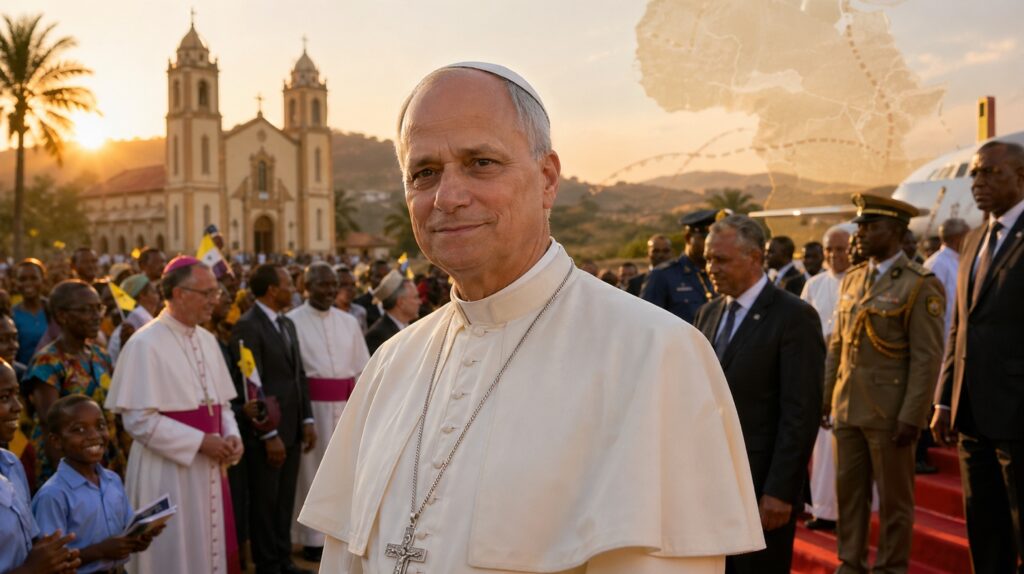
The journey is coming to an end, but it will leave its mark. In ten days, Léon XIV will have traveled through four African countries – from Algeria to Equatorial Guinea, via Cameroon and Angola – outlining, step by step, the contours of a strategy deeper than it seems.
This trip was not just a pastoral tour. It carried a political message. Challenged by Donald Trump for his perceived overly conciliatory positions, the Pope chose to respond without frontal controversy, but with consistency. From Algiers, he reiterated a clear line: Catholicism is neither a force of domination nor an instrument of brutal influence. It is, first and foremost, a testimony.
Read also: TRIBUNE – Lebanon, Hezbollah and the pope’s visit: A strategic and symbolic tale
This positioning takes on a particular significance in Algeria, a 98% Muslim country, where the Christian faith does not flaunt itself. It is characterized by discretion, almost withdrawal. Where other religious currents prioritize visible expansion, the Catholic Church accepts its numerical marginality to better anchor itself in social fabric. Education, health, charitable action: all are levers of a diffuse yet persistent presence.
This choice is not without risks. Contemporary Africa has become a space of heightened religious rivalries. Evangelical churches are burgeoning at great speed, despite restrictions – around forty of them have been closed in Algeria – while Islamic influences are also recomposing themselves. In this ever-changing landscape, Catholicism is no longer hegemonic. It must adapt, at the risk of fading away.
Léon XIV seems to have made a different bet: that of the long term. In Cameroon and Angola, he emphasized training, youth empowerment, and the consolidation of educational institutions. Less spectacular than media-driven shows of strength, this strategy aims to structurally organize societies in the long run. It is based on a belief: influence does not diminish, it is built.
Read also: ANALYSIS – How Pope Francis redefined the Church’s ties with Africa
But the journey also highlighted the persistent fragilities of the continent. Blatant inequalities in Angola, political tensions in Cameroon, the paradox of wealth and poverty in Equatorial Guinea: everywhere, deep fractures appear. Faced with these challenges, the pontifical discourse oscillates between moral exigency and pragmatism. It calls for social justice while concretely supporting grassroots actors, often alone in addressing state deficiencies.
One central question remains: is the strategy of discretion still audible in a world saturated with power dynamics and communication? In an era where powers advance with uncovered faces, where ideologies assert themselves unabashedly, the choice of silent testimony may seem counterintuitive.
Yet this is the path that Léon XIV claims. A less visible Church, but more deeply rooted. Less conquering, but more consistent. In a changing Africa, this bet is not just spiritual: it is eminently political.
Read also: Burkina Faso confronted with the jihadist scourge