After miraculously escaping an assassination attempt in 2024, Donald Trump has been emphasizing his religious rhetoric since returning to the White House. However, by trying too hard to get closer to heaven, the American president could end up burning his wings, as recent controversies have shown.
It was supposed to be just another post among the dozens he publishes daily on his social network. Last Monday, April 13, Donald Trump probably did not anticipate the media storm he would provoke by sharing an image portraying him as Jesus, healing a sick person with a touch.
Fond of glorifying montages, the American president is no stranger to this kind of action. But the political use of the image of Christ seems to have crossed a red line. Even within his very religious MAGA base, the image was shocking. So much so that the American president decided to delete the post, a backpedaling move unseen since the publication of a racist video targeting the Obamas.
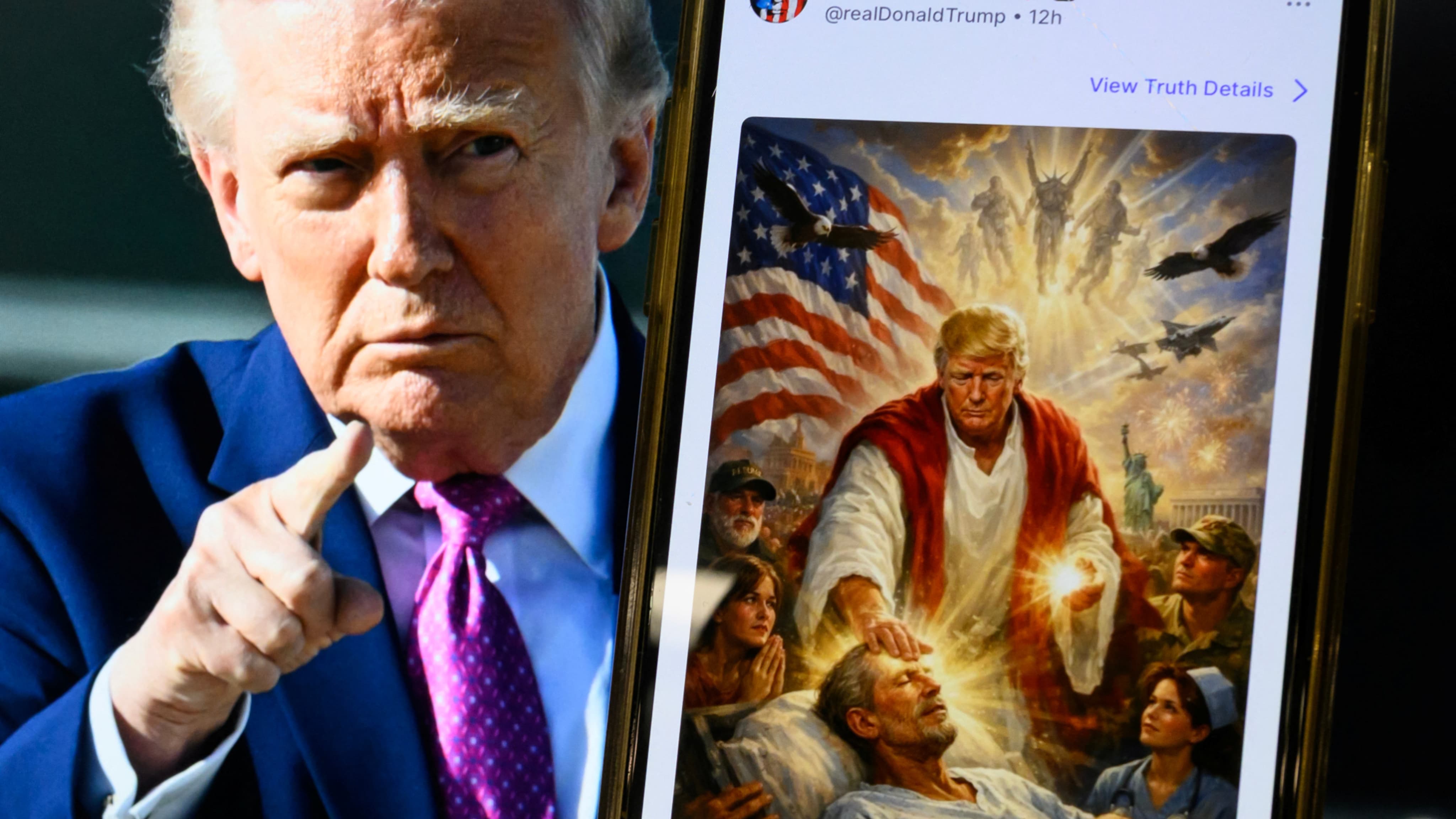
The president shared the image following a violent diatribe against Pope Leon XIV, a message perceived as an attack by many American Catholics. This recurring controversy sheds light on the very peculiar relationship Donald Trump maintains with religion.
“Religion is back”
Since his return to power, belief in God permeates all layers of his presidency. “Religion is back,” declares the Republican.
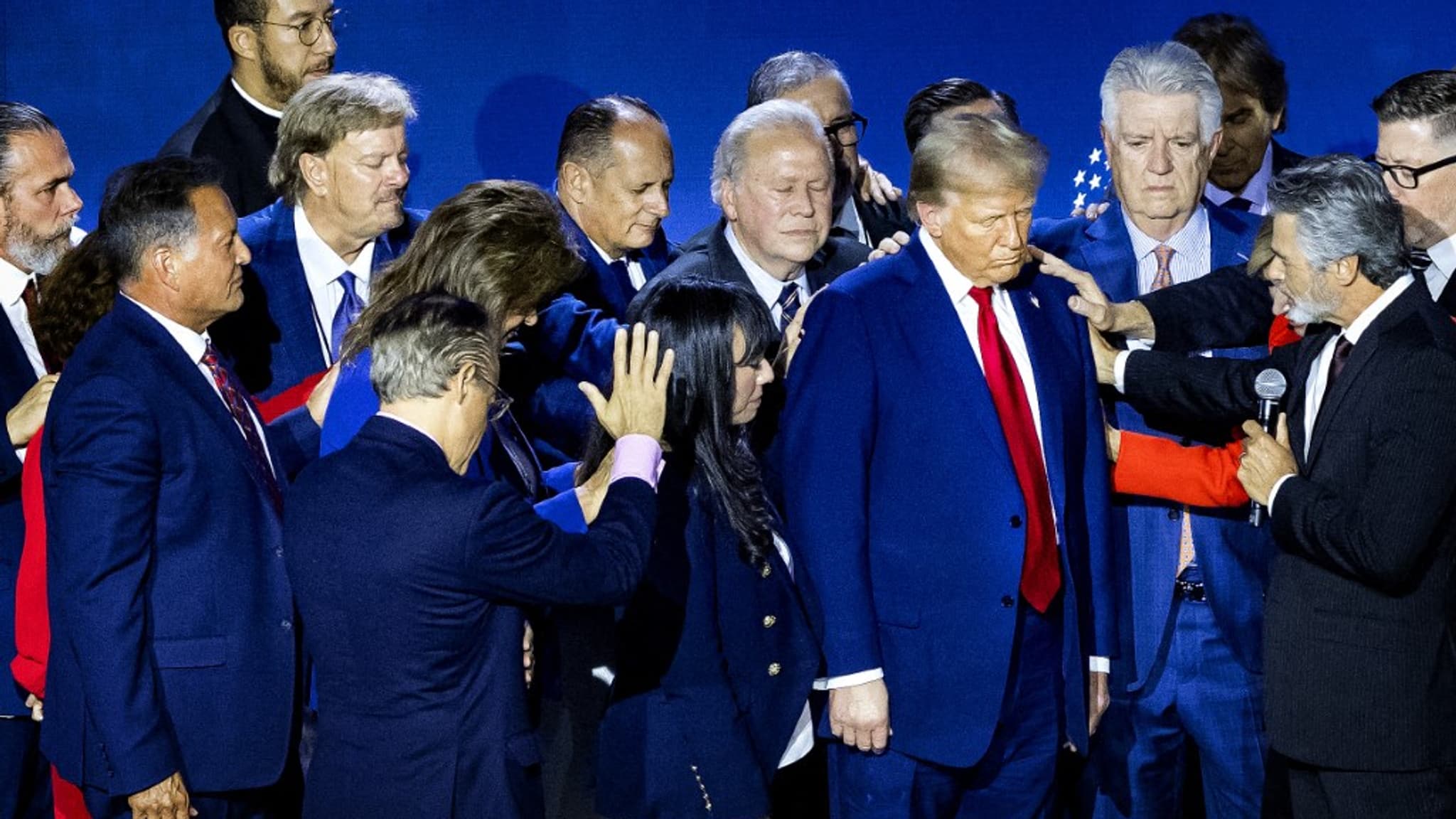
While his predecessor Joe Biden lived his faith in a private sphere, Donald Trump displays an ostentatious devotion, such as when he sets himself up in front of cameras during collective prayer sessions.
The political use of religion is not new for Donald Trump, but it has intensified since the assassination attempt he survived during the 2024 campaign. Since the day he narrowly escaped death, the billionaire claims to be “saved by God” to fulfill his destiny: to thwart America’s fate and make it “great again.”
Theology of prosperity
Contrary to what he may imply, Donald Trump has never been a very devout practitioner. Raised in New York in his Scottish mother’s Presbyterian faith, he attended the Marble Collegiate Church in Manhattan with his parents, where he got married twice. The Trump family listened to the sermons of Norman Vincent Peale, an apostle of “positive thinking” who advocates an exaggerated self-confidence.
Walking a thin line between religion and self-help, the pastor offers his flock advice on how to succeed in life both spiritually and materially. This discourse is close to the “theology of prosperity” – in which personal wealth is synonymous with divine reward – that resonates with Donald Trump.
However, the real estate developer he became quickly deserted the church. When he launched his first presidential campaign in 2015, the Marble Collegiate Church issued a statement saying that the Republican candidate was “not an active member” of the community, contrary to what he claimed in the press.
Donald Trump’s attraction to religious matters quickly appeared to be very superficial. Although he claims the Bible is his “favorite book,” he stumbled in an interview when asked about his favorite verses. “I prefer not to go into details because it’s very personal to me,” he dodged the question the first time, before being pushed by the journalist. “Do you prefer the Old Testament or the New Testament?” “Probably both equally,” Donald Trump responded.
Alliance with evangelicals
Although he is not a devout churchgoer, Donald Trump quickly realized that he needed to rally conservative religious groups to his side, especially evangelical Protestants who represent 20% of Americans.
“Donald Trump mobilizes a nationalist ideology with a Christian background and provides assurances on social issues like abortion, gender, or ‘wokeism,'” explains Francois Mabille, director of the Geopolitical Observatory of Religion at the Iris institute.
The American president appointed conservative judges to the Supreme Court, who in 2022 handed a historic victory to evangelicals by reversing federal abortion rights. He also took various measures promoting “religious freedom,” particularly within federal agencies, where the Trump administration now allows officials to proselytize among their colleagues.
In return, Donald Trump benefits from the support of a devoted community – 82% of white evangelicals voted for Trump in 2024 – an influential one. “Evangelicals represent a financially powerful movement internationally, with strong media outlets on social networks and television among evangelists,” details Francois Mabille.
Accustomed to vulgar and misogynistic remarks, condemned for sexual assault, and barely or not practicing: Donald Trump’s profile seems far from that of a model believer. But for many Christian stakeholders, he is the right person to advance their ideas. “They made a deal,” summarizes Francois Mabille.
Donald Trump, “instrument” of God
Among evangelicals, a more radical and mystical fringe sees Donald Trump not just as a politician, but as a messianic figure come to save America. Some media outlets present the billionaire as a divine “instrument.” “The hand of God is upon him, and he cannot be stopped,” declared preacher Lance Wallnau in 2024 before the presidential election.
Paula White, a televangelist who has become very close to Donald Trump, even compares him to Jesus: “You have been betrayed, stopped, and falsely accused. It’s a familiar pattern that our Lord and Savior has shown us. But it did not end for Him, nor will it for you,” she declared last April.
This narrative has been reinforced by the assassination attempt from which Donald Trump miraculously escaped. “Something changed in me… I feel even stronger. I believed in God, but I now believe much more firmly,” affirms Donald Trump.
This message of rebirth, typical of evangelical imagery, “brings Trump closer to conservative communities who are attentive to any declaration of a renewal of faith; he presents himself as one of them, not just as one of their political allies,” explain political science researchers Laurie Boussaguet and Florence Faucher on The Conversation.
A divisive view of religion
Since his return to power, Donald Trump’s policy has become more and more coated with a religious veneer, but also a more identitarian one. Where former presidents chanted “God bless America” as a unifying slogan, Donald Trump embodies a more divisive vision of religion than just religious conservatism.
“He activates a very binary political discourse of ‘us’ against ‘them,’ and ‘us’ are the white Christians,” decrypts religion specialist Francois Mabille.
More than a driving force, religion is for Donald Trump a tool he uses to wage a cultural war against Democrats. The American president asserts that Christians were “persecuted” under Joe Biden’s presidency, despite his fervent Catholicism.
To remedy this situation, the president signed an executive order to combat “anti-Christian prejudices” within the administration, and most notably created a brand new “faith office.” Located at the heart of power, this body, in the hands of evangelicals, advises the president on religious matters and has authority over the allocation of public funding to religious institutions.
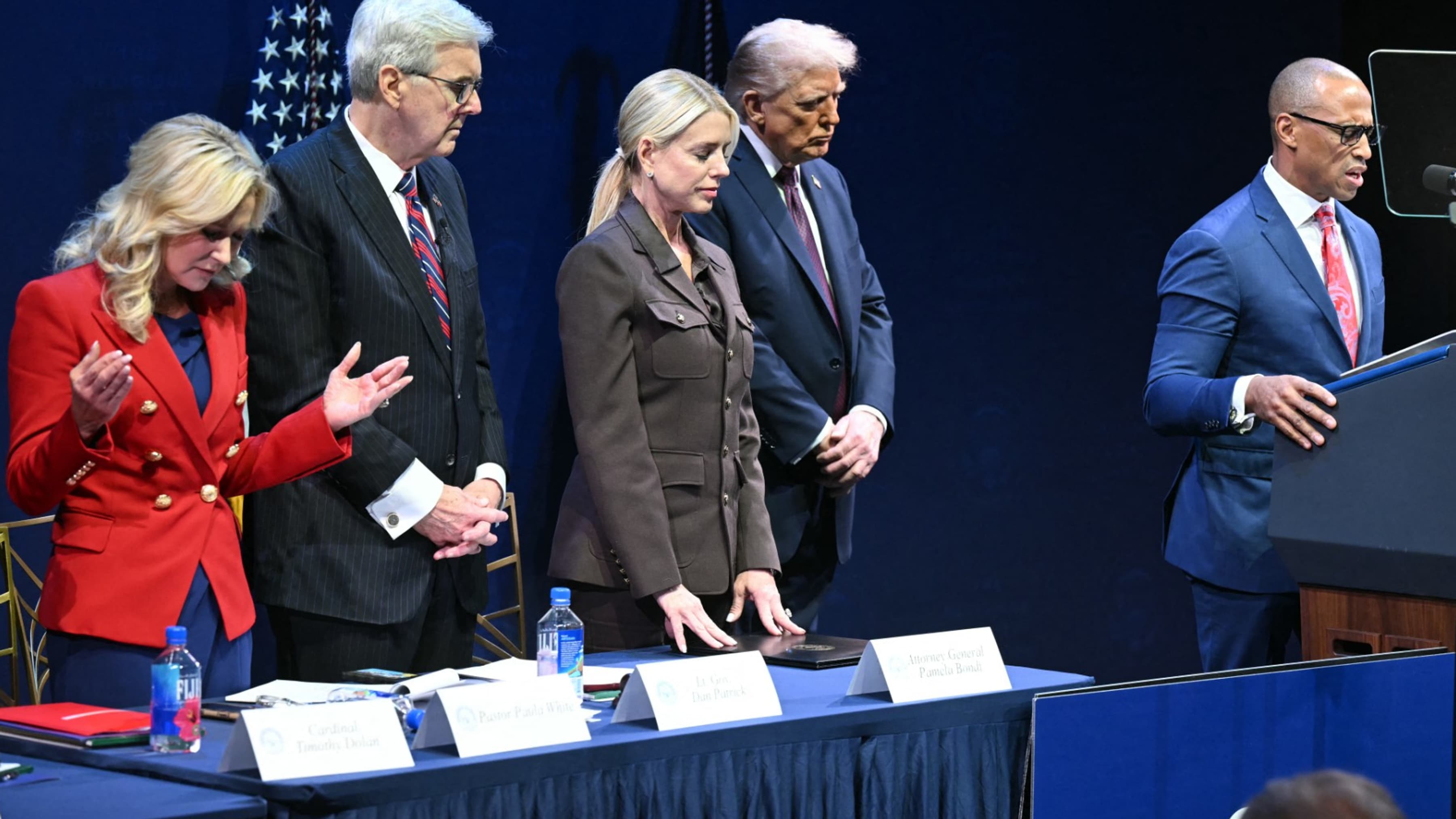
The office is led by Donald Trump’s spiritual adviser, Paula White. This vibrant preacher, who made headlines in 2020 for a fiery sermon supporting her candidate, has greatly facilitated the rapprochement between the American president and the evangelical galaxy, which was previously more attracted to other Republican candidates like Texas Senator Ted Cruz.
Among the many evangelical factions now orbiting the American president is the Dominionism. This movement believes that Christians must exert their dominance in various sectors of society: family, religion, education, media, entertainment, and especially government.
“According to interpretations, this dominance can be achieved either by establishing a theocracy, i.e., a non-democratic Christian state, or by influence from the grassroots through media and political institutions,” explains Francois Mabille.
Fantasized Christian foundations
Some preachers close to the president also have “an extremely strong influence on Trump’s pro-Israeli policy,” adds Francois Mabille, as many evangelists see support for the state of Israel as the fulfillment of biblical prophecies.
By institutionalizing “the presence of conservative religious figures within the federal government,” the Trump administration “reveals that power now intends to derive its legitimacy from the privileged support of an identified community, rather than democratic procedures,” argue political science researchers Laurie Boussaguet and Florence Faucher.
According to them, the faith office also “challenges the separation of church and state in the United States.” Indeed, “the First Amendment to the United States Constitution prohibits the establishment of an official church,” as political scientist Denis Lacorne explains on Sciences Po’s website, detailing how Donald Trump fantasizes about the Christian nature of the American nation.
“For Trump and his entourage, the founding texts of the American Republic all have a biblical origin, and to reinforce this reconstruction of American history, Trump published the God Bless the USA Bible,” which combines the Protestant Bible, the Declaration of Independence, and the 1787 Constitution, accompanied by the text of Lee Greenwood’s song, God Bless the USA (1984),” details this U.S. specialist.
“A gross blasphemy”
Self-proclaimed defender of Christians, Donald Trump nevertheless did not hesitate to attack one of his highest representatives, Pope Leon XIV. Already very critical of Francis, who had criticized the violence of his anti-migrant policy, the American president violently attacked his successor, whom he saw as not supporting his unilateral war against Iran. The message he posted on his Truth network shocked many American Catholics, including the most conservative ones.
By insulting the leader of some 70 million American worshippers, Donald Trump risks alienating an electorate he had managed to win over in 2024, especially through his Vice President J.D. Vance, who recently converted to Catholicism.
“His message was very poorly received, especially since the pope is American,” points out Lauric Henneton, a U.S. specialist at BFM. “When it was Pope Francis, at a stretch, he was an Argentine pope, somewhat distant, and who also had this intolerable pro-migrant agenda in the eyes of the Maga right. With Leon XIV, it’s different,” adds the lecturer at the University of Versailles Saint-Quentin-en-Yvelines.
Beyond just Catholics, the image of Donald Trump depicted as Jesus has upset Christians in general, including the most loyal supporters of Donald Trump. “It’s a gross blasphemy. Faith is not an accessory,” criticized MAGA influencer Brilyn Hollyhand. Former Republican lawmaker Marjorie Taylor-Greene, who recently broke with Donald Trump, went even further. “It’s more than blasphemy. It’s the spirit of the Antichrist,” she said, echoing an expression used by other MAGA supporters.
“Weariness” in the religious electorate
White evangelicals remain among the most staunch supporters of Donald Trump, but their support for his policies dropped from 66% to 58% in a year, according to a study by the Pew Research Center published last February. This political risk seems to have been realized by Donald Trump, who removed the problematic image.
For Lauric Henneton, these controversies reveal the true nature of Donald Trump’s relationship with the Christian faith, purely electoral. “Donald Trump is his own prophet. He has only one religion, himself and the dollar,” he asserts.
A few months before the midterm elections, the situation is even more serious, as the president’s popularity among his MAGA base is weakened by the war in Iran and the Epstein affair. In an apparent effort to turn the situation around, Donald Trump plans to read a passage from the Old Testament publicly next week as part of an event celebrating the Bible. It remains to be seen whether the president’s extraordinary political resilience will once again allow him to weather the storm.
“Just because there is controversy does not mean there will be electoral desertion,” warns Americanist Lauric Henneton, who nonetheless recognizes a “weariness” among the religious electorate. According to the specialist, one element will play in favor of the Republican: “even if they don’t like him, many conservatives will still vote for Trump because, on the other side, are the Democrats.”