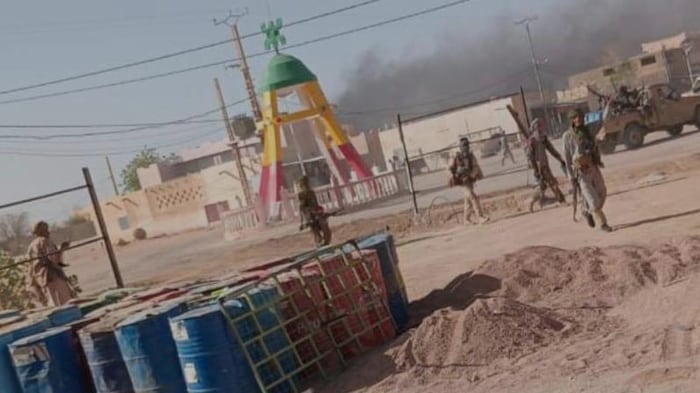
Intense fighting was reported on the outskirts of the Malian capital, Bamako, and in several important cities of the country between the Malian army and “terrorist groups” carrying out coordinated attacks on Saturday, April 25. The Sahelian country of Mali, led by a junta, has been plagued by conflicts and jihadist violence for over a decade, but these are the most serious attacks against the junta by jihadists and the Tuareg rebellion of the FLA in years.
“We are facing a large coordinated offensive across the country at a level unprecedented since 2012, when the government lost half of the country. There have been serious security failures in Bamako,” commented Charlie Werb, an analyst from the consulting firm Aldebaran Threat Consultants (ATC), to AFP.
On Saturday afternoon, the clashes between the army and the attackers, which began at dawn, continued intensively on the outskirts of Bamako and in several cities, especially in Kidal, the historical stronghold of independent armed groups in the North. The Tuareg rebellion of the Azawad Liberation Front (FLA) claimed responsibility for the takeover.
Kidal was recaptured in November 2023 by the Malian army, supported by fighters from the Russian paramilitary group Wagner, ending over a decade of control by rebel groups.
The FLA also claimed to have taken control of several positions in the Gao region (north), according to statements on social media. In messages on X, their spokesperson, Mohamed Elmaouloud Ramadane, stated that “several positions have already come under the control of the Azawad forces,” adding that they are “continuing their progress inside the city of Kidal.”
The jihadists of the Group for Support of Islam and Muslims (JNIM), affiliated with Al-Qaeda, also claimed on Saturday a series of coordinated attacks with the Tuareg rebellion. In a statement, the JNIM, which has been fighting against the military in power in Bamako for years, proclaimed a “victory,” attributing it to “hard work,” coordination with their “partners,” and “thanks to the active participation of our brothers from the Azawad Liberation Front.”
“Together we are undergoing a real transformation, in service of religion, the country, and the people,” the group declared in their statement. The JNIM took “responsibility” for the attacks that targeted the “presidential seat of Malian President Assimi Goïta, the seat of Malian Defense Minister Sadio Camara, the international airport of Bamako, and the military sites in the neighboring city of Kati,” stronghold of the junta. The jihadists also claimed to have “taken total control of the city of Mopti (central Mali) and control most of the army and mercenary strongholds in Sévaré (central) and Gao (north).”
Meanwhile, the African Union (AU) stated “strongly condemns” these attacks by armed groups, warning that they “risk exposing civilian populations to significant dangers.” After announcing that “unidentified terrorist groups had targeted certain points and barracks in the capital and interior this morning,” and that fighting was ongoing, the Malian army later declared in a new statement that the situation was “under control,” despite ongoing gunfire, and that “several terrorists had been neutralized and equipment destroyed.”
“The JNIM and the FLA have launched coordinated attacks in Mali. Many positions of the army and the Africa Corps (Russian paramilitary organization) are still being targeted in Kati, Kidal, Sévaré, and Gao,” summarized Hasret Kargün, an Africa researcher at the intelligence firm Mintel World. “The chances of retaking cities like Kidal and Gao without military support are very slim. Air support will be the decisive factor for both sides,” he noted.
Mali is governed by military personnel who seized power through two coups in 2020 and 2021. The country has been facing a deep security crisis since 2012 due to violence from jihadist groups affiliated with Al-Qaeda and the Islamic State (IS), as well as communal criminal groups and separatists.
/2026/04/25/69ecfef8b4605681013905.jpg "War in the Middle East: Iranian pilgrims arrive in Saudi Arabia for the pilgrimage to Mecca")