What Happens to Airplanes When They Stop Flying? A French Company Has the Answer
Have you ever wondered what happens to airplanes after they reach the end of their life? No?
Well, today’s topic is about a French company that has become the world leader in the “afterlife” sector of airplanes: TARMAC Aerosave.
Founded in 2007 in Tarbes, in the Hautes-Pyrénées region, by three giants: Airbus, Safran, and Suez, it is now the global leader in green recycling of airplanes and engines.
An airplane is not dumped in the trash, and TARMAC Aerosave understands that!
A commercial aircraft weighs between 40 and 280 tons, depending on the model. It is made up of aluminum, titanium, carbon fiber, copper, technical plastics, thousands of mechanical and electronic parts. Its average lifespan is around 25 to 30 years. When an airline decides to retire an aircraft from its fleet, because it consumes too much, because it’s too old, because regulations are changing, what do they do with this mass of materials and technology?
For a long time, the answer was: not much glory. Airplanes abandoned in American deserts, others being cannibalized to recover some parts, many ended up crushed without method or traceability. The aviation industry, so strict in the air, was much less so on the ground, at the end of life.
It is exactly this gap that TARMAC Aerosave decided to fill!
The one-stop-shop for end-of-life aircraft
The company’s philosophy is to treat an airplane as an industrial object whose entire trajectory is managed, from temporary storage to complete dismantling. This is what the company calls the “complete life cycle.”
When an airplane arrives at TARMAC Aerosave, several scenarios are possible.
First case: the company just wants to park it for a while due to a rough patch (an economic crisis, a pandemic, fleet restructuring, etc.). The plane is then stored, maintained, monitored, ready to go back into service.
Second case: the aircraft changes ownership or airline. It must then be reconfigured, inspected, brought up to standards for its next operator.
Third case: the aircraft will never fly again. It is dismantled.
In this last scenario, TARMAC Aerosave deploys a meticulous process. The usable parts: engines, landing gear, avionics, cabin equipment are disassembled, certified, and reintroduced into the spare parts market. Non-reusable materials such as aluminum, titanium, or copper are sorted, valued, and sold to recycling channels.
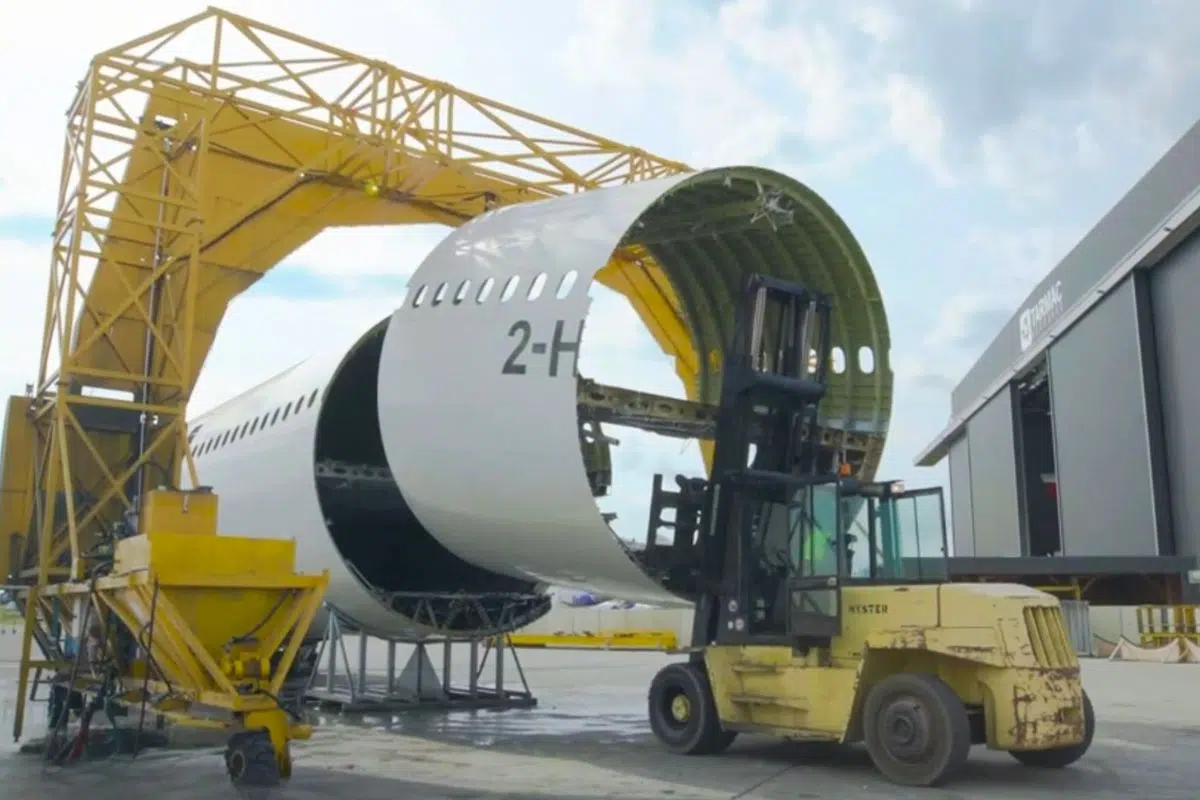
The recovery rate exceeds 90%. For an industry of this complexity, it is a remarkable performance!
Three sites, hundreds of airplanes, and a world record
TARMAC Aerosave operates on three sites in Europe: Tarbes and Toulouse in France, Teruel in Spain. Together, they can accommodate up to 280 airplanes and 120 engines simultaneously, making it the largest storage capacity on the continent.
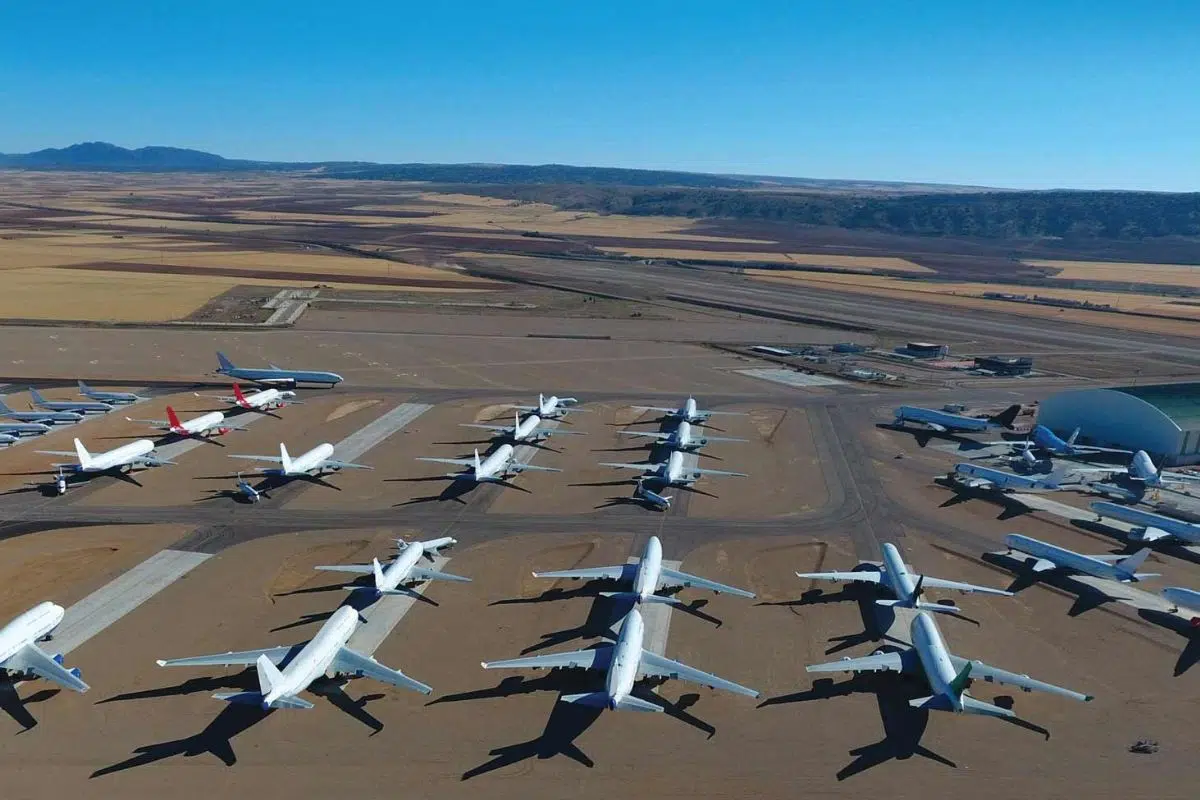
The Tarbes-Lourdes-Pyrénées site, located in Azereix (65380), is the group’s historical heart and concentrates much of the technical know-how. In Spain, the Teruel airport (44396) plays a central role in large-scale storage, with vast areas capable of accommodating hundreds of aircraft. Finally, Toulouse-Francazal, in Cugnaux (135 avenue du Comminges, 31270), complements the group by specializing more in single-aisle aircraft and regional fleets.
Three sites, three complementary functions, but one logic: covering the entire life cycle of aircraft, from storage to return to service or dismantling.
Since its inception, the company has welcomed over 1,470 airplanes, delivered over 1,000 aircraft into service, and dismantled over 360 aircraft and 190 engines. In 2019, it achieved a world first by recycling an Airbus A380 (the world’s largest aircraft, with a wingspan of 73 meters, of which it valorized over 90% of the mass).
To give you an idea: the A380 weighs about 280 tons empty. Recycling 90% of this mass means recovering the equivalent of 250 tons of materials that are reused in industrial processes rather than ending up in landfills.
Born in France, recognized worldwide
TARMAC Aerosave is the result of a French industrial cooperation with three shareholders for three complementary logics.
Airbus brings the technical knowledge of aircraft and access to manufacturers. Safran masters engines and equipment. Suez brings expertise in waste management and circular economy. Without this triptych, the company would probably never have seen the light of day, or would not have achieved this level of credibility so quickly.
TARMAC Aerosave holds EASA and FAA Part 145 approvals (the two major civil aviation authorities in Europe and the USA) as well as a series of quality and environmental certifications. This regulatory portfolio allows it to work for any global company, whether operating Boeing or Airbus aircraft.
Among its clients: Lufthansa Technik, AerCap, Etihad Airways Engineering, Airbus itself. Names that speak for themselves!
A sector that will explode in the next ten years
The global aircraft recycling market was worth $5.3 billion in 2024. By 2034, it is expected to “explode” and reach $13.2 billion (11.24 billion euros), a 2.5X increase in less than 10 years! Airbus estimates that over the next twenty years, more than 19,000 older airplanes will be replaced, generating approximately $52 billion in reusable parts and materials. An entire industry is evolving.
The driving force behind this growth? The massive fleet renewals worldwide. New aircraft generations consume 20 to 25% less fuel than their predecessors. Airlines have no choice: they accelerate retirements, mechanically fueling the demand for dismantling and recycling.
TARMAC Aerosave clearly has a lead, but the competitive landscape is evolving rapidly. The United States still dominates the market with 53.6% share in 2024. China is investing heavily; Airbus even launched its first global recycling center in Shanghai in January 2024. Players like Vallair or specialized airport entities are gaining strength. The industry, once relatively confidential, is now attracting capital and global ambitions.
The real question in the coming years is not whether the market will grow (that is a given), but whether France will defend this rare industrial leadership.
Some figures to conclude on TARMARC Aerosave:
| Indicator | Figure |
|---|---|
| Aircraft welcomed since inception | +1,470 |
| Aircraft delivered into service | +1,000 |
| Aircraft dismantled | +360 |
| Engines dismantled | +190 |
| Material recovery rate | +90% |
| Simultaneous hosting capacity | 280 aircraft / 120 engines |
Sources:
TARMAC Aerosave, About us (consulted in April 2026),
https://www.tarmacaerosave.aero/about-us
official page presenting the activities of TARMAC Aerosave, specializing in aircraft storage, maintenance, and recycling, with an overview of its sites and industrial capacities.
Aeromorning, Tarmac Aerosave has returned 1,000 aircraft to flight (June 20, 2023),
Global Market Insights, Aircraft recycling market – Size, share, and trends analysis (November 2024),
https://www.gminsights.com/industry-analysis/aircraft-recycling-market