A Colorado climber who survived a perilous fall near Wolcott in winter of 2025 is now speaking publicly about it. That includes the massive rescue effort that followed. It also involves the new emergency whole blood program in Eagle County that she believes allowed her to survive and preserve her quality of life afterward.
Josie Mudjitaba had more than a decade of climbing experience before heading out for what was supposed to be a normal climbing day last November.Â
“With any sport, there’s risk and things like that,” Mudjitaba told CBS Colorado. “But this really doesn’t happen in terms of pulling off a rock (and) a rock severing the rope.”
CBS 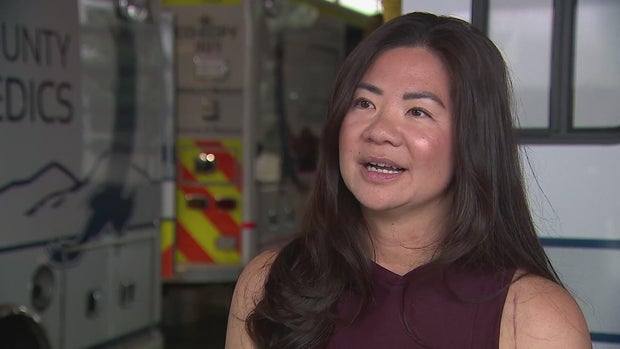
She said the fall happened after she climbed above a bolt on the route.Â
“The last thing I remembered was climbing,” Mudjitaba said. “… I fell about 40 feet.”
Mudjitaba said she was fortunate the ground below her was steep instead of flat, and that likely contributed to her successful recovery. Still, her injuries were severe.
“I pretty much fell on my left side,” Mudjitaba said. “So six fractured bones, fractured pelvis, sacrum, my rib, and then I guess I hit my shoulder so hard that it fractured several bones on my shoulder as well. And then of course my head suffered a concussion, (traumatic brain injury).”Â
Mudjitaba said she drifted in and out of consciousness while rescuers, who were nearly 45 minutes away from her location, worked to reach her so the could eventually stabilize her.Â
“It was really in and out,” Mudjitaba said. “I just felt like I couldn’t move, but the smallest movement also provided extreme pain.”
Nearly 30 rescuers responded to help bring her out of the remote climbing area — made up of Eagle County Paramedics Services, Vail Mountain Rescue Group and local firefighters. Paramedic Chris Rauzi with ECPS said dispatch information immediately raised concerns.
“We have a female patient in her 40s who is conscious and breathing, but has significant injuries and is unable to walk,” Rauzi recalled when he spoke to CBS Colorado. “So, with that, I’ve got alarm bells already going off in my head.”Â
Rauzi said the remote location made the call even more challenging, a familiar challenge working in the mountainous region.
“Any type of big trauma like this, especially when it’s going to be a prolonged hike to get in and a prolonged amount of time to access the patient, it’s a good idea to bring the most pertinent tools that you have,” Rauzi said. “And we just got whole blood.”
Shared with CBS 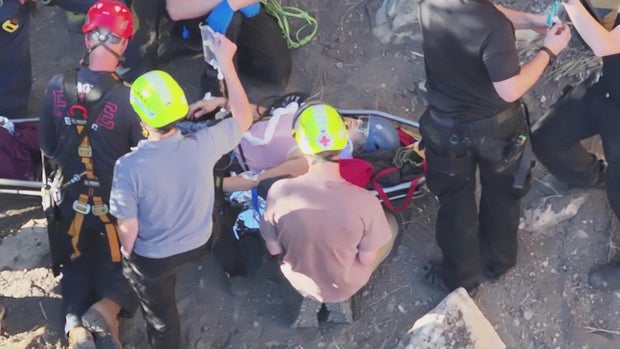
Eagle County paramedics now carry whole blood units in specialized coolers on both the east and west ends of the county since October 2025, allowing crews to begin advanced trauma care before patients ever reach a hospital.Â
“Basically, just bringing a higher level of care to people in the field,” Rauzi said. “Getting them that care that they need faster without that time delay from where we find them to arriving at the hospital.”Â
It’s something crews find especially helpful with limited medical expertise in local hospitals that are occasionally not equipped to handle the level of trauma seen in accidents like Mudjitaba’s.
Mudjitaba says her condition deteriorated as rescuers prepared to lower her from the scene.
“By the time they were ready to lower me, my vitals kind of changed,” she said. “My blood pressure dropped. My heart rate went up. I became really lethargic.”Â
Mudjitaba said the whole blood she received in the field likely changed the trajectory of both her survival and recovery.
“It saved my life,” she said. “Without it, maybe I could have survived. Who knows? But my vital organs could have collapsed, and my recovery could have been prolonged.”Â
Mudjitaba said mountain rescues come with a difficult reality in rural Colorado. Advanced trauma care can be hours away.
“We were two hours away just to get to the helicopter, and then another half an hour to get to Denver,” Mudjitaba explained. “So time wasn’t on my side, and whole blood kind of bridged that gap.”
“People just think about life or death,” she added. “But oftentimes we have to think about when you do survive, what does that look like? It’s not just life or death. It’s the quality of that life.”
For Rauzi, the program represents a major leap forward for mountain emergency medicine. “I’ve been working as an EMT and paramedic for about 12 years,” Rauzi said. “There’s definitely been some cases out there where I’d just wish I know what the patient needs, but I don’t have it. But, now, we do.”
Eagle County officials said locally donated blood can directly support local hospitals and emergency crews. Upcoming blood drives are scheduled from 10 a.m. to 3 p.m. Wednesday, May 20 at the Gypsum Recreation Center, and from 9 a.m. to 2 p.m. Friday, May 22 at the Edwards station for Eagle County Paramedic Services. More information is available through the Eagle County Paramedic Services website.Â
Before the fall, Mudjitaba was already a regular blood donor herself. Her life-changing experience and her reception of whole blood, thanks to the team who saved her, has changed her relationship with blood donation forever.Â
“It’s very different,” she said. “I never thought that I would be on the receiving end.”
Now, she says she has firsthand experience with how important those donations can be.
“I’m grateful for it,” Mudjitaba said. “They just started the program, and I’m one of the first few recipients for it, and I needed it, and it saved my life.”Â