
In mid-April, several countries not directly involved in the conflict expressed readiness to establish a “neutral mission” to secure the strait.
British and French defense ministers will hold a video conference on Tuesday with counterparts from countries willing to contribute to a mission to secure the Strait of Hormuz, to discuss their respective “military contributions,” London announced on Sunday. Tehran warned on Sunday of a “decisive and immediate response” by the army in case of French and British deployment in the Strait of Hormuz, following Paris and London’s announcement of sending military vessels to the region.
However, French President Emmanuel Macron assured on Sunday evening that France had “never considered” a deployment in the Strait of Hormuz. The approximately forty countries involved “should take advantage of tomorrow’s meeting to discuss and define their military contributions to the offensive mission aimed at reopening and securing the Strait of Hormuz when conditions allow,” the British Ministry of Defense stated in a press release.
“Neutral Mission”
In mid-April, several countries not directly involved in the conflict that began on February 28 with American-Israeli strikes on Iran expressed readiness to establish a “neutral mission” to secure the strait. During a conference co-chaired in Paris by French President Emmanuel Macron and British Prime Minister Keir Starmer, the goal was to “accompany and secure merchant ships transiting through the Gulf,” according to Macron, while Starmer referred to it as a “peaceful and defensive force.”
The United States and Iran, the warring parties in the conflict, did not participate in the talks. London had already announced the positioning “in the Middle East,” without further details, of a destroyer, the HMS Dragon, previously stationed in the eastern Mediterranean. On the other hand, Paris announced on May 6 the dispatch of the aircraft carrier Charles de Gaulle to the Gulf.
During Tuesday’s meeting, “our role will be to ensure that we do not just talk, but that we are ready to act,” affirmed John Healey, the British Defense Minister, who will co-chair the meeting with his French counterpart Catherine Vautrin.
1500 Blocked Ships
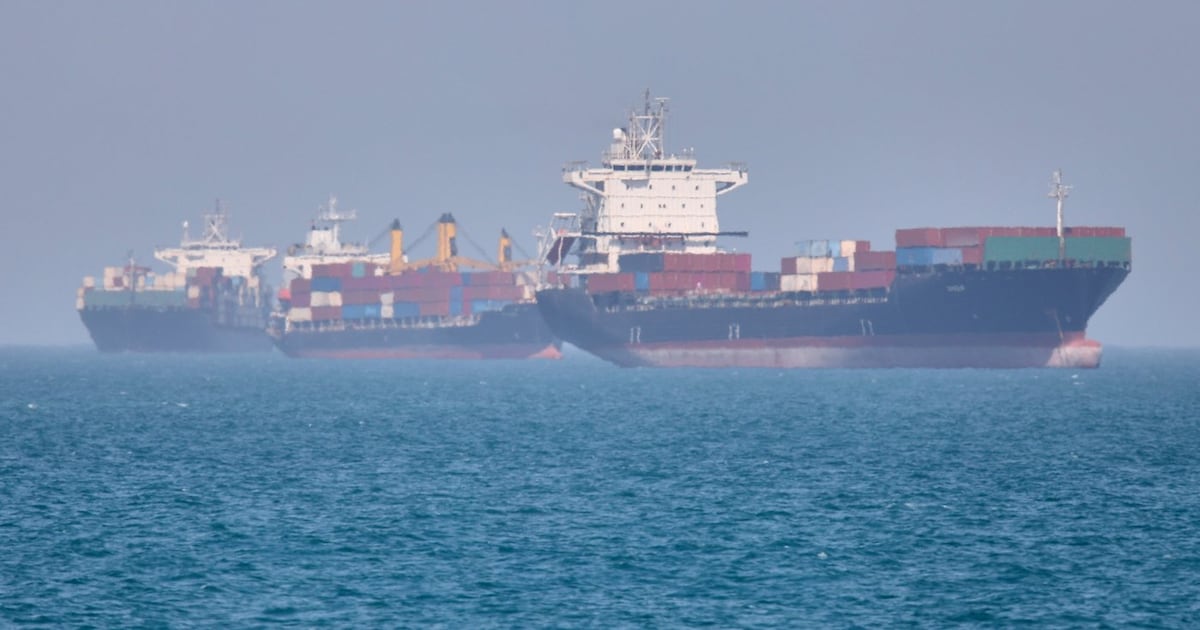
The blockade by Tehran of the strategic Strait of Hormuz for maritime transport, especially of hydrocarbons, has shaken the global economy, with about 1,500 ships and 20,000 crew members stranded. The strait has become a major hotspot of tensions between the United States and Iran, with sporadic clashes occurring despite the ceasefire in effect since April 8.
On the other hand, Washington has been blockading Iranian ports since April 13, while negotiations to permanently end hostilities are ongoing. On Sunday, a cargo ship was reportedly struck off the coast of Qatar, with Iran claiming it “flew the American flag and belonged to the United States,” without explicitly claiming responsibility for the attack.
The United States and Gulf countries urged the UN Security Council on Thursday to demand that Iran stop “preventing” navigation in the strait. A draft resolution to that effect was submitted by Washington and Bahrain, but Russia (an ally of Tehran) indicated its readiness to block the text.


/2026/05/10/6a00f5ea32939623907513.png "Ligue 1: PSG almost champion, Nice now play")
:fill(black)/2026/05/08/69fe00eadea66216469199.png "The little secrets of cinema sound designers")

