There is this old epistemological debate: can we really formulate laws, stable principles to understand politics? There are several answers and several schools, I particularly like the one proposed by Italian political scientists who assert, with a certain elegance, that there are no rules in politics – but there are regularities.
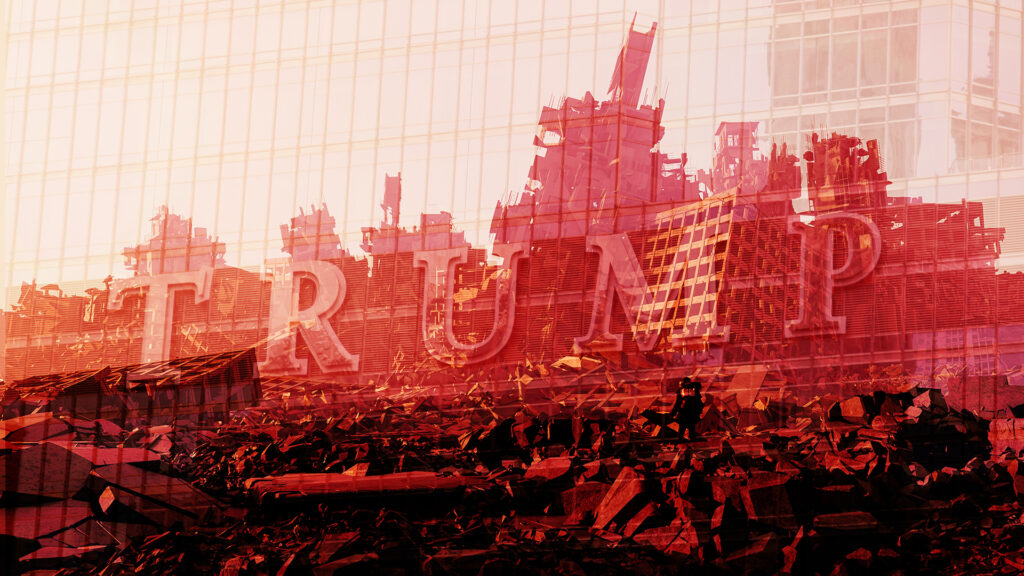
And for the past few months, there is one that is becoming hard to ignore. So this morning, almost solemnly, I propose giving it a name: the Trump Effect. Definition: in a given political trajectory with known characteristics – the Trump Effect denotes a rise in intensity such that it causes a non-linear and potentially catastrophic transformation of this political trajectory and the field itself.
An example will make things much clearer. Giorgia Meloni had decided to align herself with Trump. She had spoken at MAGA rallies, she had been to Mar-a-Lago even before her inauguration – she had even asked her son Donald Trump Junior to write the preface of her book in English: I AM GIORGIA.
Her bet was simple: to become, by ideological proximity, the transmission belt of Europe to the new White House. The problem is that this second Trump mandate has very little left in terms of transactions: we are no longer in the deal but in the balance of power – therefore, displaying oneself as a “deal maker” exposes to risks.
At the height of the crisis in Greenland, Meloni continued to hope for a Nobel Prize for the American president. However, the political cost of this positioning has become untenable. Despite good polls and unprecedented governmental stability, Meloni lost her constitutional referendum a month ago. Since then, under internal pressure, she has been making numerous turnarounds.
On Iran, on Israel, she finds herself today – paradoxically – closer to the socialist Pedro Sánchez – who has in the meantime become the preferred figure of the Italians – than to the White House. The American president realized this week and attacked Meloni for the first time, saying he was “shocked”.
And here, another paradox appears: these attacks – coming from the one she had presented as her greatest ally – do not weaken her, but strengthen her. Because Trump is nothing like a normal political figure.
His impact resembles less that of a foreign head of state than that of a media machine: he is everywhere, on our screens, in our conversations. He is causing “a new geopolitical divide” – in the words of Jean-Yves Dormagen in the Grand Continent – eventually politicizing even those who are not interested in politics.
So let’s be clear: the populist crisis has not disappeared. Its underlying reasons are still there – sometimes even stronger. But Trump’s second term consistently produces an unexpected effect: it becomes an electoral brake for his own allies in Europe.
Instead of accelerating the real dynamic of the far-right, the American president complicates it. We see it in Italy – we saw it in Hungary, where the Trump Effect contributed to Viktor Orbán’s defeat after 16 years of dominance.