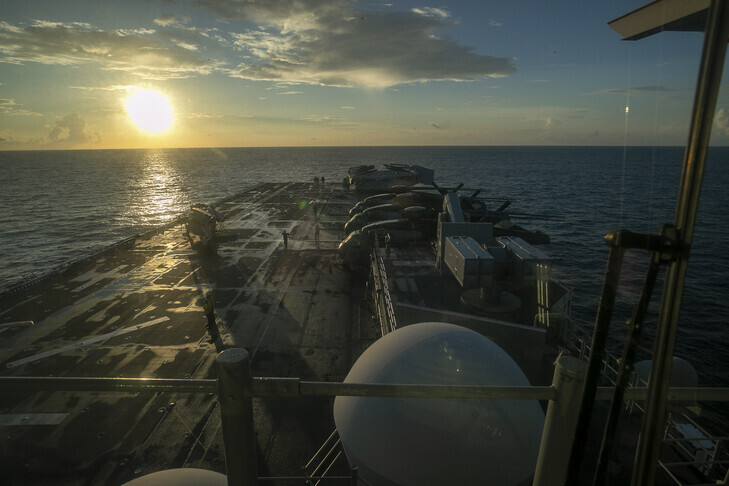
In a context marked by tensions in the Middle East, the French defense tool is adapting and accelerating its pace. While the military ports of Brest and Toulon appear particularly understaffed, the French Navy officially announced the active service entry of the Jacques Stosskopf on Tuesday, May 19th, according to the Ministry of the Armed Forces. Delivered to the “Royale” in November, this vessel integrates into operational loop much faster than its sister ship, the Jacques Chevallier.
The latter, delivered to the Navy by Naval Group and Chantiers de l’Atlantique in July 2023, required a long testing phase – both dockside and at sea – before being declared fully operational in November 2024, sixteen months later. This acceleration is deliberate: “France is not at war, but the geopolitical situation requires us to increase the tempo, and that’s what we are doing,” said an officer to JDD. This dynamic comes as Paris has deployed its aeronaval group near the Strait of Hormuz.
In this context, the Jacques Stosskopf could soon be called upon. “Admiral Nicolas Vaujour, Chief of Staff of the Navy, declared the vessel’s active service on May 7, 2026. It is now fully operational and can be deployed at any time on the orders of the Chief of Staff of the Armed Forces,” noted the Ministry. This commissioning offers more options for the staff, who may decide to integrate it into the escort of the aircraft carrier Charles de Gaulle.
More broadly, the replenishment oilers (BRF) are intended to modernize the logistical capabilities of the French Navy. They are gradually replacing the Durance class fleet replenishment oilers, which have been in service since the 1990s, becoming obsolete due to aging and non-compliance with current standards, especially in terms of fuel transport with a single hull.
With a displacement of 31,000 tons, a length of 194 meters, and a width of 24 meters, the BRFs have a double hull and four versatile refueling masts, allowing them to support two vessels simultaneously. Their role is central in naval operations: they transport freight, fuel, and ammunition, providing essential logistical support at sea. Capable of carrying up to 150 sailors, their function is strategic: the BRFs contribute to French deterrence by supporting the deployment of ballistic missile submarines.
For self-defense, the Jacques Stosskopf is equipped with two 40mm cannons and a Simbad-RC air defense system. It can also carry an NH90 Caïman helicopter and an aerial drone, enhancing its operational capabilities. Furthermore, the advancement of this new generation of ships continues: the third unit in the series – which will total four – the BRF Émile Bertin was launched in Saint-Nazaire last April.
/2025/04/14/maxnewsworldsix099854-67fd0ad299f64760319375.jpg "INFO FRANCEINFO. War in the Middle East: the activity of nearly 80% of French SMEs affected by the conflict, according to CPME")