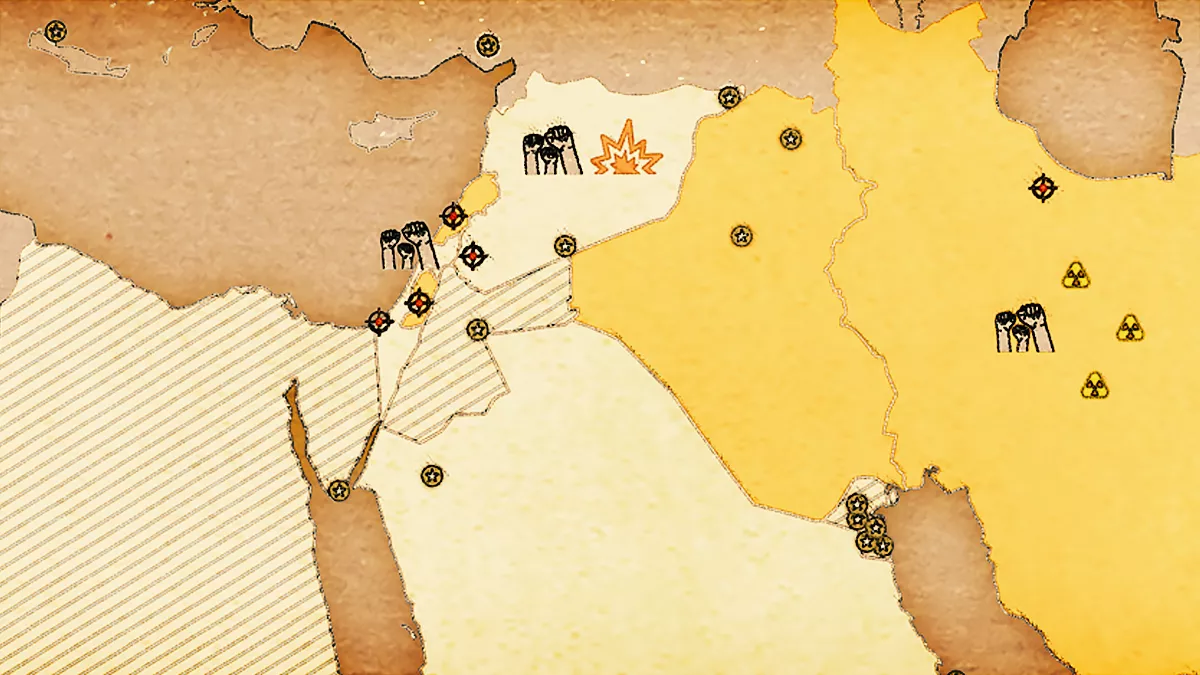
The confrontation between Israel and Iran, the epicenter of the conflict in the Middle East, has been brewing for decades. But it has broadened the battlefield. A Pandora’s box has been opened that we cannot seem to close. The Iranian question is reshaping the region,” analyzed Ifri specialist Dorothée Schmid at the “World Policy Conference”, whose 18th edition took place in Chantilly.
For the first time since the Russian invasion of Ukraine in 2022, Russia and Vladimir Putin were notably absent from the conference, organized every year by Thierry de Montbrial, the president of the French Institute of International Relations. It was as if both had been engulfed by the waves of the tsunami covering the Middle East since the start of the Israeli-American operation against one of the most repressive and dangerous regimes on the planet. “I often say that my nightmares are better than my days, because at least they disappear when you wake up,” commented Nabil Fahmy, former Egyptian Minister of Foreign Affairs and new Secretary General of the Arab League, illustrating the chaos that has gripped the region and the traumas caused by the transformation of the world.
Hope for the disappearance of the Iranian threat
Political leaders and experts from around the world gathered in Chantilly to agree that, despite the “informational fog” that still prevents analysts from making sense of the crisis, the war in Iran, whatever its outcome, has already profoundly changed the Middle East.
“This conflict is different from others. For the first time, the Strait of Hormuz was closed. For the first time, non-belligerent countries – the Gulf states – were attacked by Iran. The threat has also changed: it now mainly comes from drones and light equipment,” analyzed Jihad Azour, Middle East Director at the IMF.
While Israeli-American bombings weakened Iran’s military infrastructure, the regime changed its deterrence strategy. Long based on the nuclear program, ballistic missiles, and proxies in the region, it is now organized around the Strait of Hormuz, a formidable lever for Tehran, but also around drones, easy to produce and cheap.
The Iranian attacks on the Gulf states and their civil infrastructures have opened wounds that will take a long time to heal, especially in countries that had taken hesitant steps towards reconciliation with Iran.
“It is illusory to believe that we can restore trust between the United Arab Emirates and Iran. We cannot be attacked with 2,800 missiles and drones and then talk about trust. It will take an eternity,” warned Anwar Gargash, influential diplomatic adviser to the Emirati President.
The former Minister of Foreign Affairs of the Emirates hopes that one day the Middle East will be rid of the Iranian threat. As long as the “ideological projects led by extremists – Hamas, Hezbollah, and the Israeli right-wing – are defeated,” he still believes in the extension of the Abraham Accords, which have brought his country closer to Israel and which are still “a platform for cooperation” for him.
“What Iran has done to the Gulf countries is unacceptable. But my country wants to have good relations with both Iran and Israel,” said Nabil Fahmy, former Egyptian Foreign Minister.
Everywhere, people are eagerly awaiting the day after, not knowing what it will look like, as its advent partly depends on the changing decisions of Donald Trump.
Some, citing Israel’s “strategic loneliness,” see the future in a dark light, like Itamar Rabinovich, vice-director of the Institute for National Security Studies (INSS) in Tel Aviv. “As long as the Iranian regime remains, nuclear and ballistic threats will persist. Hezbollah will not disappear. Hamas will remain in Gaza. And Lebanon will still be occupied by a foreign militia. Israel must therefore prepare for a future confrontation with Iran.”
Others believe that Israel has already gained a lot from this war, which has temporarily eliminated the Iranian threat and reduced its capacity for harm in the world.
However, the continuation of negotiations between Americans and Iranians will not necessarily mark the end of the story. “The Iranian threat will not disappear. The regime has been preparing for this war and has recently proven that it can quickly reconstitute its ballistic arsenal,” says Anne Claire Legendre, President of the Arab World Institute. She envisions three scenarios for the day after: an identical Iranian regime, a regime with a new “behavior,” and a regime change. What chance?
“We are at a crossroads. We don’t know what agreement will be signed or what security will emerge. This is the first time that what is happening in the Middle East has consequences worldwide,” warns Jihad Azour, IMF official.
After hoping that an Israeli version of the Venetian scenario could change the nature of the Islamic regime, Donald Trump now believes that economic pressure on the Strait of Hormuz will suffocate and defeat it. But at what cost, especially as the American president is pressed for time by the democracies, that is, by electoral deadlines? “We are at a crossroads. We don’t know what agreement will be signed or what security will emerge. This is the first time that what is happening in the Middle East has consequences worldwide,” says Jihad Azour, IMF economist.