A vintage chest passed down from generation to generation has revealed a well-kept secret: an unreleased film by Georges Méliès, missing for over a century. Discovered by chance in the United States, this reel adds to the history of French cinema.
The old wooden chest had been in the family for a century, moved from the attic to the barn, from the barn to the garage over generations. No one knew it contained a treasure of French cinema.
No one, until Bill McFarland, a retired professor and great-grandson of a rural Pennsylvania projectionist, found old film reels that “seemed too valuable to be thrown away,” he said. But the seventy-year-old “had no idea what they were” or how to view them. He first tried to sell them to an antique dealer, who refused after learning that nitrate reels were highly flammable and could explode.
Last summer, Bill McFarland traveled from his home in Michigan to the Library of Congress’s National Audiovisual Conservation Center in Culpeper, Virginia. Among the ten reels was a lost film by Georges Méliès, a French cinema pioneer, called “Gugusse et l’automate.”
A film made in 1897 by Georges Méliès
The film was made in 1897, two years after the Lumière brothers organized the first public film screening in Paris. Georges Méliès, a magician, attended the screening and later became known for experimenting with early special effects in cinema.
Five years later, in 1902, Georges Méliès created “A Trip to the Moon,” considered one of the first science fiction films. He released his final film in 1913 before fading into obscurity and becoming a toy seller in a shop at Gare Montparnasse in Paris, as the center of cinema moved from Europe to America.
Georges Méliès was one of the “first film directors,” according to George Willeman, head of the nitrate film collection at the Library of Congress, who believes the reel found by Bill McFarland is likely a third-generation copy of the original.
“A film that had never been seen before with ‘timeless’ jokes”
Méliès’ films suffered from piracy, making him “one of the first filmmakers to face piracy,” according to George Willeman. He is also said to have destroyed a hundred of his negatives, with the melted film used to make boots for soldiers during World War I.
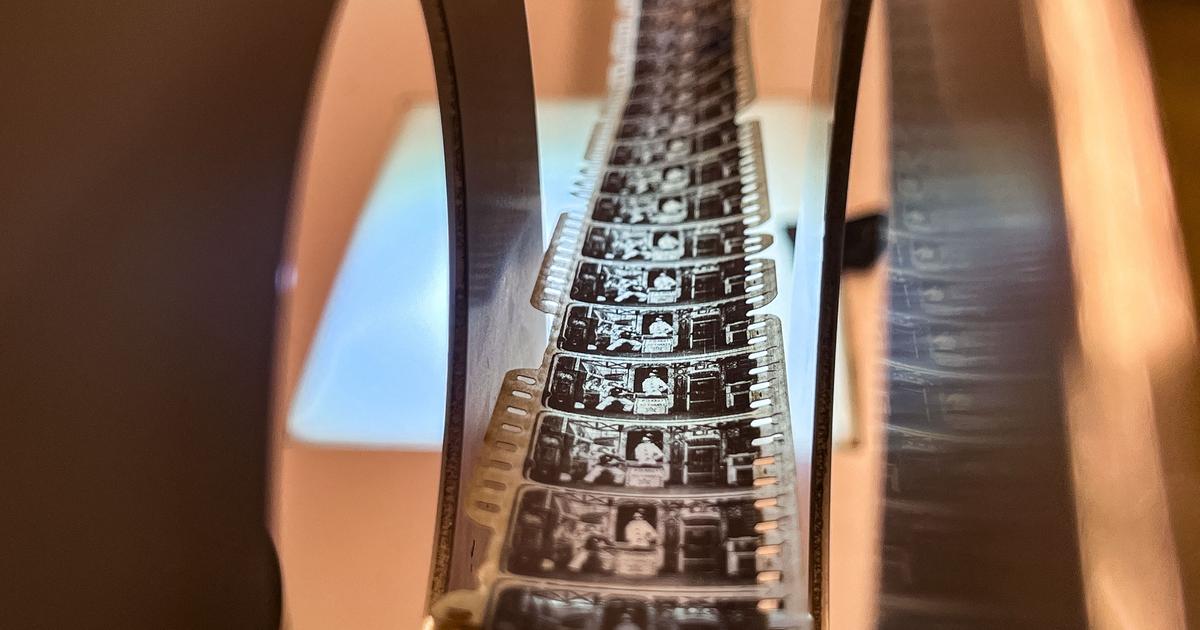
Although “Gugusse et l’automate” is listed in the illusionist’s catalog, it had never been seen until Bill McFarland brought his reels to Culpeper last September. In the film, Georges Méliès plays a magician operating a crank that gradually makes an automaton grow before hitting the magician on the head with a stick. The magician retaliates by striking the automaton with a hammer until it shrinks and disappears through a editing process.
“These shots are very precise for such an old film, and the jokes are timeless,” marvels Jason Evans Groth, curator of animated images at the Library of Congress.
“‘Gugusse et l’automate’ is now a piece of history”
Bill McFarland’s great-grandfather, William DeLyle Frisbee, was born in 1860 in Pennsylvania. In his spare time, he left his potato fields and beehives to travel around with the latest Edison phonograph and magic lantern, eventually adding a projector and films.
Travel accounts recorded in worn notebooks document Willam DeLyle Frisbee’s voyages. “I gave a show in Garland, five dollars in revenue, tough crowd,” reads one of his journals, referring to a small town in Pennsylvania. “I suppose on a Saturday night, perhaps they were a little drunk,” Bill McFarland imagines. “Maybe there were disappointed customers, or just too loud? Or maybe they were excited by the images.”
A century later, the archivists at the Library of Congress were equally excited about the film reels. They kept the precious reels in a cold room specially designed to prevent any fires from the nitrate. The room also houses tens of thousands of films dating back to Hollywood’s golden age.
The archivists spent a week restoring and digitizing the reel. Over time, the film had shrunk and torn, but it was still in good condition despite being stored in a barn or attic exposed to sunlight for years. “Gugusse et l’automate” is now a piece of cinema history, accessible on the Library of Congress’s website.