Print the article
By Giuseppe Gagliano, President of the Centro Studi Strategici Carlo De Cristoforis (Como, Italy)
The shadow finance as a new battleground
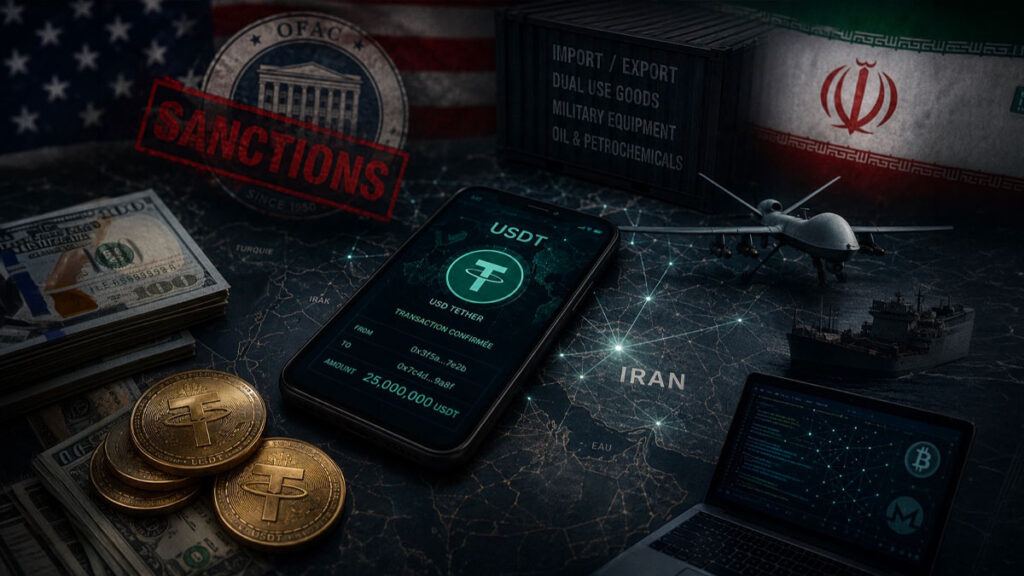
Contemporary warfare is no longer fought only with missiles, drones, blocked tankers, and military bases. It also takes place in the invisible circuits of digital finance, where money no longer necessarily goes through banks, doesn’t wait for authorizations, hardly recognizes borders, and often arrives before the control devices. The Iranian case demonstrates this with brutal clarity: a country subjected to years of American sanctions manages to use a digital version of the dollar to continue funding its military equipment, strategic supplies, and regional operational networks.
The paradox is evident. Washington seeks to exclude Tehran from the international financial system, but a part of the cryptocurrency ecosystem offers Iran an alternative corridor. This is no longer just about smuggling, shell companies, or commercial triangulations. We are facing a form of constant, fast, decentralized financial mediation that is difficult to grasp. The stable digital currency, pegged to the dollar and largely backed by US Treasury securities, becomes an instrument for sanctioned actors to move value, pay suppliers, bypass restrictions, and keep a war machine alive under pressure.
American debt as unintentional security
The heart of the problem lies in the nature of these so-called stable digital currencies. These instruments promise users a value linked to the dollar. To support this promise, issuing companies often hold reserves in the form of US public debt securities. In simple terms: American debt gives credibility to the instrument, the instrument circulates on global digital markets, and hostile actors to the US can use it for operations that the traditional banking system would block.
Nobitex and the Iranian laboratory
The role attributed to Nobitex, the main Iranian cryptocurrency exchange platform, is crucial because it shows how a sanctioned country can build its internal infrastructure for converting between national currency, digital assets, and external markets. In an economy struck by inflation, currency devaluation, and international restrictions, these channels become not only investment instruments or protection against value loss, but also nodes of strategic finance.
Military evaluation: drones, missiles, and logistics
From a military point of view, the issue is not only about money. It concerns the continuity of the supply chain. Drones, electronic components, guidance systems, dual-use materials, spare parts, software, transportation, and payments to external suppliers require an agile financial network. An armed force may have arsenals and industrial capacities, but without secure payment flows, it becomes more difficult to purchase, replace, and modernize.
Economic scenarios: the dollar against itself
Economically, this case shows the dark side of American financial power. The more central the dollar is, the more attractive each of its derivations becomes. The more Treasury securities are viewed as safe, the more they can be used as indirect collateral by global private instruments. The result is a system in which the US monetary hegemony can be exploited by their adversaries.
Geopolitics of short-circuit
Iran is not just a national case. It is a precedent. Russia, North Korea, criminal networks, armed groups, and revisionist powers closely observe this new architecture. Stable digital finance allows isolated economies to connect to global markets without entirely going through traditional channels. It does not eliminate sanctions, but it reduces their effectiveness.
The monster born of innovation
While the West has often presented cryptocurrencies as innovation, freedom, efficiency, any financial technology, when it reaches critical mass, becomes power. And any power can be used against those who made it possible. The private digital dollar, created to speed up markets, can become a survival instrument for sanctioned states.