This French giant manufactures no chips, yet without it, global AI comes to a stop.
Air Liquide will invest €200 million in Japan to build two ultra-pure gas production units in Hiroshima, scheduled to start operations in 2028.
These facilities will provide ultra-high purity nitrogen, oxygen, and argon crucial for manufacturing next-generation chips. These chips power artificial intelligence models, data centers, and supercomputers.
Without these gases, no modern production line can operate. An invisible impurity can ruin thousands of wafers in minutes. It is a bottleneck for the entire industrial chain held by a French company!
Read also:
From the heart of Taiwan to Japan, Air Liquide thrives in Asia
Invisible yet vital molecules
Semiconductor production requires as clean an environment as possible.
Ultra-pure gases play a crucial role as they are used in several critical stages of production:
- Surface cleaning
- Avoiding any unwanted chemical reaction
- Maintaining stable pressures
- Protecting sensitive components
A chip plant can consume millions of cubic meters of gas per day.
The ultra-pure gas market is dominated by a few players capable of meeting these standards:
- Linde: about 18% of the market
- Air Liquide: about 15%
- The remaining 67% is shared among groups like Air Products and Chemicals, Messer Group, or Matheson Tri-Gas
Thus, only two players control nearly a third of the global market.
This segment, estimated around $7.5 billion in 2024, could reach nearly $12.8 billion by the end of the decade. This growth is directly driven by semiconductors, representing about 20% of total demand.
A booming semiconductor industry
The semiconductor market could triple from $1.033 trillion in 2026 to over $3.1 trillion in 2035, nearly tripling in less than ten years.
This growth is fueled by three main drivers: artificial intelligence, electric vehicles, and data centers.
Asia overwhelmingly dominates global production with 80% of the total, including 46% just for Taiwan (even 90% for the most advanced global chip production).
Air Liquide is also present in the advanced materials market
Air Liquide is not only involved in ultra-pure gases but is also establishing itself as a player in an equally strategic field: advanced materials used directly in nanoscale chip manufacturing.
Specifically, these are extremely complex molecules used in processes like ALD (Atomic Layer Deposition), a technique for depositing atom layers one by one with near-perfect precision. At this level, a chip is not “manufactured” but literally built layer by layer.
To accompany this rising complexity, Air Liquide has profoundly transformed its industrial strategy. The company no longer produces remotely: it installs itself at the heart of technological ecosystems.
In Taichung, Taiwan, over a billion euros have been invested since 2019 to develop advanced material production capabilities. In Hwaseong, South Korea, it operates the world’s largest molybdenum-based solutions plant, with its Subleem® range used in the most advanced engraving and deposition processes.
Instead of delivering a standardized product, Air Liquide now works hand in hand with chip manufacturers to design molecules adapted to future semiconductor generations, with the global semiconductor market estimated at $50.4 billion in 2023 and potentially exceeding $157 billion by 2033.
A massive industrial presence in Asia
Just weeks before announcing the €200 million investment in Japan, Air Liquide had already inaugurated an advanced materials plant in Taiwan, where up to 90% of the world’s most advanced AI chips are concentrated.
Taiwan is the epicenter, the obligatory gateway for the entire global digital industry. Smartphones, cloud, artificial intelligence…but the rest of Asia also heavily influences this market as the continent hosts 80% of global semiconductor production.
Air Liquide is deeply ingrained (whether in ultra-pure gases or advanced materials) and here are the main identified industrial sites of the group in the region:
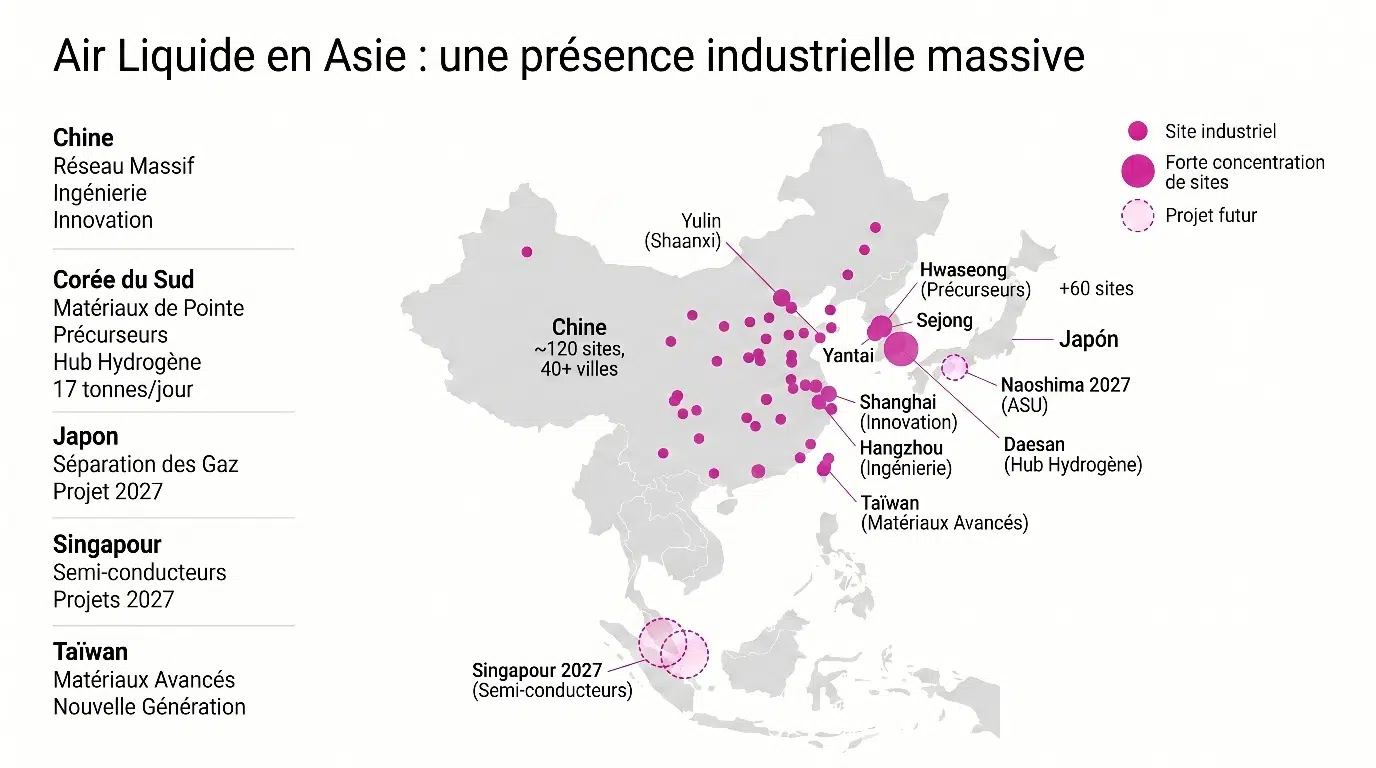
| Country | Site | Activity | Specificity |
|---|---|---|---|
| China | +120 industrial sites | Gases, engineering, R&D | Presence in over 40 cities |
| South Korea | Hwaseong / Sejong | Advanced materials | Critical precursors for semiconductors |
| Taiwan | Taichung | Advanced materials | At the heart of the most advanced fabs |
| Singapore | New units (2027) | Industrial gases | Strategic regional hub |
| Japan | Naoshima / Hiroshima | Ultra-pure gases | Expansion linked to AI chips |
The discreet but essential role of Air Liquide
We discussed it before in a previous article, but France, which had a significant role in semiconductor production in the early 90s, no longer weighs much today (perhaps 1% of global production).
While this race may be lost, it can be said that France is well positioned in the bottleneck of the entire industry: ultra-pure gases.
Air Liquide will clearly have a significant role to play in a market set to triple by 2035 and increasingly central to modern geopolitical issues.
Sources:
- Air Liquide, Air Liquide invests €200 million in Japan to support a semiconductor leader (April 16, 2026)
Official press release detailing Air Liquide’s investment in Japan to support the semiconductor industry, focusing on high-purity gases and associated infrastructure. - Spherical Insights, Advanced Materials for Semiconductor Market (July 2024)
Analysis report on the market for advanced materials for semiconductors, presenting growth trends, key segments, and long-term outlook. - Business Research Insights, Semiconductor Market Report (April 6, 2026)
Detailed report on the evolution of the global semiconductor market, including demand dynamics, major players, and growth projections. - Fortune Business Insights, High Purity Gas Market (April 6, 2026)
Analysis report on the high-purity gas market, essential for the semiconductor industry, with data on growth, applications, and major suppliers.