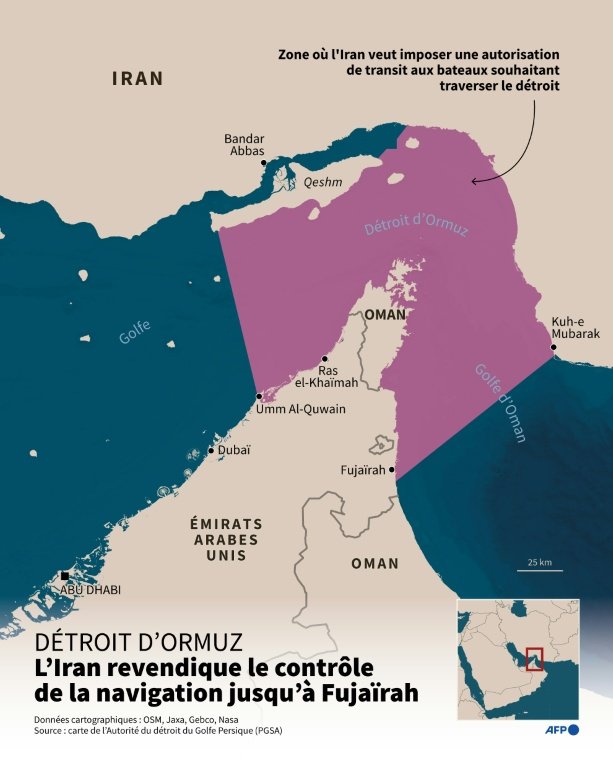
According to American media, this agreement would allow ships to pass through the vital Strait of Hormuz again, easing the sanctions on Iran. The thorny nuclear issue would be deferred to further negotiations. CBS News, citing sources close to the discussions, says the proposal would include unfreezing some Iranian assets in foreign banks and continuing negotiations for an additional thirty days, a deadline also reported by the Wall Street Journal.
Towards the lifting of the blockade of the Strait of Hormuz?
The discussed agreement does not address how Iran would specifically get rid of its stocks of enriched uranium, which would be the subject of upcoming negotiations in the weeks or months to come, as reported by the New York Times citing American officials.
The spokesperson for the Iranian Ministry of Foreign Affairs stated on Saturday that Tehran was in the “finalization phase” of an agreement protocol with Washington. However, the nuclear issue is not part of the current agreement under discussion. This agreement does involve the lifting of the naval blockade imposed by the United States on Iranian ports and the strategic Strait of Hormuz, effectively blocked by Iran since the beginning of the war initiated by the United States and Israel on February 28.
Pakistan’s efforts
Pakistan’s Prime Minister Shehbaz Sharif, a mediator in these negotiations, on Sunday hinted at a multi-phase resolution of the conflict, expressing hope to “soon host the next round of negotiations.” The first talks, held on April 11 in Islamabad between senior American and Iranian officials, were unsuccessful.
The “broadly negotiated” agreement with Iran, “subject to finalization,” includes the opening of the Strait of Hormuz, as stated by US President Donald Trump on his Truth Social platform. His statement followed discussions with leaders from Gulf states, Turkey, Egypt, Jordan, and Pakistan.
President Trump also mentioned a “positive” phone call with Israeli Prime Minister Benjamin Netanyahu. American media recently reported conflicting strategies between Trump, pushing for a diplomatic solution, and Netanyahu, who allegedly prefers a return to combat.
The apparent thaw in relations comes after weeks of deadlocks and threats. On Saturday, Trump assessed the chances of a “good” agreement or a return to war as “50-50,” as reported by Axios. That same day, Iran’s chief negotiator, Mohammad Bagher Ghalibaf, warned of a “crushing” response if the US resumed war with Iran, following his meeting with the Pakistani army chief in Tehran within Islamabad’s mediation efforts.
The stakes of the ceasefire
After over a month of war resulting in thousands of deaths and shaking the global economy, a ceasefire has been in place since April 8 between Iran and the United States. Diplomats in the Gulf are working to advance discussions and prevent a resumption of strikes. During the call with Trump, Qatar’s Amir Sheikh Tamim bin Hamad Al-Thani urged prioritizing peaceful solutions. The Gulf monarchy, like other US-allied Gulf states, faced retaliatory Iranian missile strikes during the early weeks of the war.
The unpopular war in the United States has severely disrupted the global economy. One-fifth of the world’s consumed hydrocarbons used to pass through the Strait of Hormuz before the conflict. Iranians express their weariness, with one individual in Paris lamenting the state of “neither war nor peace,” making even simple tasks like signing up for a gym difficult.
/2026/05/24/6a1289a995be3360183979.jpg "Shots fired near the White House, shooter killed")


/2026/05/24/6a12b6552844a867865693.jpg "Football: PSG players Matvey Safonov and Illia Zabarnyi did not shake hands during an internal friendly match")