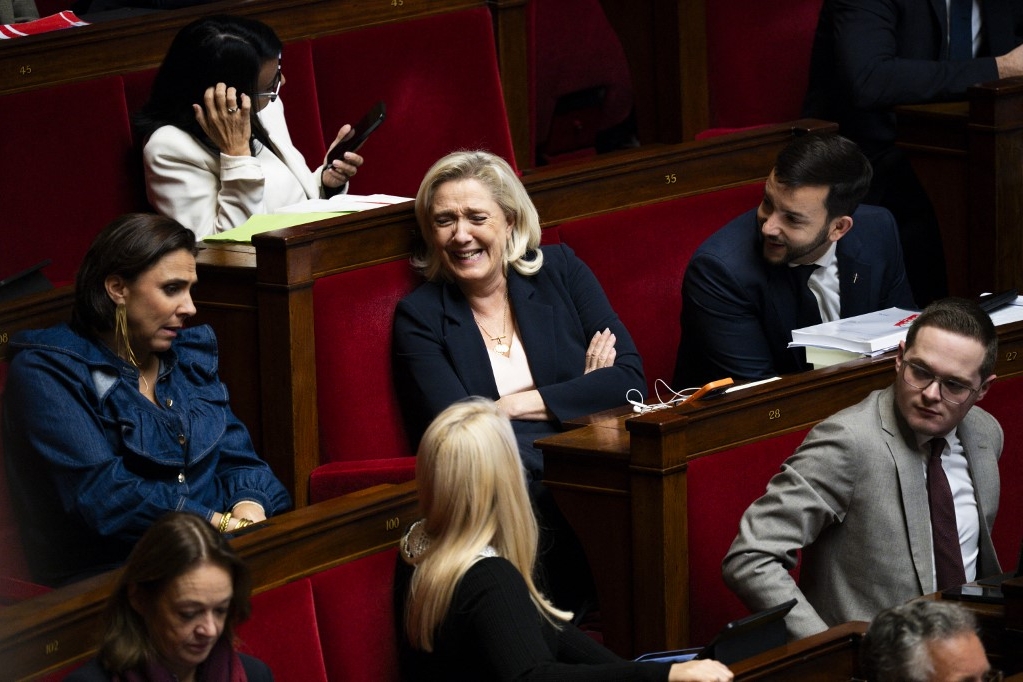
The deputies of the National Rally and La France Insoumise each submit their motion of censure against the government to protest against the decree published on the 13th of February, laying out the country’s energy strategy by 2035, it was learned on Monday.
Marine Le Pen had urged deputies to oppose this Multiannual Energy Program (PP3) and announced that the National Rally (RN) would do so if they did not. The RN deputies submitted their motion of censure on Monday, according to a source within the group.
The RN protests “on the format,” against “an illiberal act against Parliament,” and against “a declining policy that promotes intermittent energies, lies about nuclear power, and poses a major risk to public finances.”
They believe that the government should have gone through the legislative process, as required by the energy code, and criticize the “irrational choice” of intermittent energies dictated by the European Commission.
The motion of censure will be examined no later than Wednesday, due to the mandatory 48-hour period between submission and examination. However, it is unlikely to be adopted, as previous motions of censure from RN have never been supported by the left.
In response, the President of the LFI group in the National Assembly, Mathilde Panot, announced that her group is submitting their own motion of censure.
She stated, “The parliamentary group of La France Insoumise submits a motion of censure against the government and invites deputies from the NFP to cosign. It is unacceptable for decisions that will engage our country for decades to be made by decree, without debate or vote in the Assembly.”
For this motion of censure to be adopted, it would need the support of the entire left and the National Rally. However, it seems unlikely at this time that the Socialist Party, which has previously rejected motions of censure against Prime Minister Sebastien Lecornu, will support this one.
The government unveiled its new energy policy strategy on the 12th of February, after three years of intense debates and numerous delays. The strategy emphasizes increasing the consumption of low-carbon electricity, particularly nuclear power, instead of costly fossil fuels. It also involves a reduced deployment of onshore wind and solar energy.
The Senate also strongly protested the government’s decision to use a decree. A debate on the subject is scheduled for Monday afternoon in the Senate, at the request of Senate President Gerard Larcher.