Never two without three. After the first Gulf War, triggered by Iraq’s invasion of Kuwait in 1990, followed by the second (2003-2011), initiated by a US offensive in Iraq to overthrow Saddam Hussein, the Persian Gulf has been the center of a new major conflict since February 28th. As the outcome appears more uncertain than ever, this third Gulf War has plunged the entire Middle East into chaos. From Saudi Arabia to the United Arab Emirates, passing through Israel and most recently Ukraine, some balances could be permanently transformed. A look at current geopolitical issues.
1. Trust in the United States tainted Following Iranian attacks on their territory, Saudi Arabia and the Gulf petromonarchies blame Washington for choosing to protect Israel at the expense of its regional allies. “Gulf countries don’t really have an army, except perhaps the Saudis. So, they relied on Americans to defend them. Today, these countries feel that their alliance with the United States hasn’t protected them,” says François LaRochelle, a former diplomat and fellow at the Montreal Institute of International Studies.
The fact that Americans went to war without their approval also fuels their crisis of confidence. Contradictory statements by Donald Trump, both on the reasons for the war and the steps to resolve the crisis, do not help matters. Mr. LaRochelle also believes that we may witness a geopolitical realignment in the region not seen in a long time – maybe even since the first Gulf War.
2. A double consensus in the region Gulf countries find themselves in a delicate position, as they favor firmness towards Tehran but also fear the effects of war on their economies and security. “At the regional level, there is generally a consensus on two points,” explains Sami Aoun, director of the Observatory on the Middle East and North Africa at UQAM. “The first is that Gulf countries do not want Iran to be a dominating hyperpower claiming dominance over the four Arab capitals of Damascus, Beirut, Baghdad, and Sanaa.” “But at the same time, these countries also do not want Israel to become a major power in the region,” he warns.
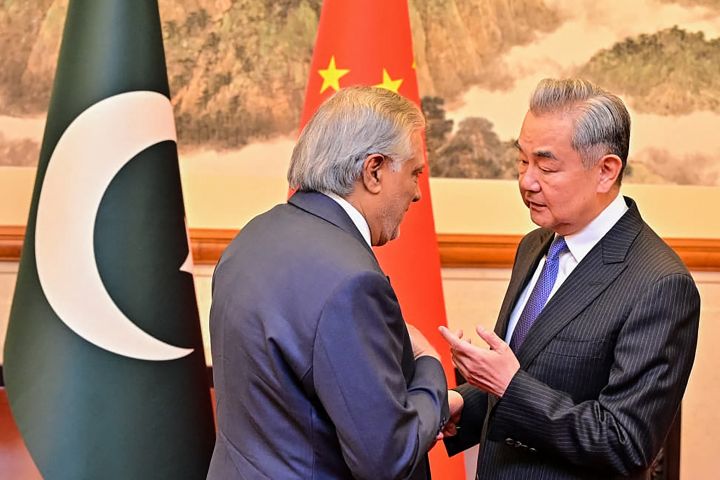
The New York Times recently revealed that Mohammed bin Salman, the Crown Prince of Saudi Arabia, is one of those who, alongside the Israelis, are pushing Donald Trump to go all the way and provoke a regime change in Tehran. In the event of a collapse of the ayatollahs’ regime, Riyadh could become the pivot of a new regional order dominated by Pakistan to the east and Turkey to the west. This is evidenced by the meeting of these three countries in Islamabad on Sunday, along with Egypt, to find a diplomatic solution to the conflict.
3. Hard to do without the United States While Gulf countries are somewhat disillusioned by the unreliability of their American ally, they still depend on US weapons and protection. Finding an alternative solution is therefore difficult. According to Dorothée Schmid, a researcher at the French Institute of International Relations (IFRI), these countries are now at an impasse, especially as they risk being left high and dry by the United States, who may weaken Iran without necessarily changing the regime in Tehran. “In the medium term, their perspective is to have to continue to coexist with the Iranian regime, the evolution of which is uncertain.”
Economically, Ms. Schmid believes that Gulf countries may be tempted to postpone some investments, notably in the United States. They could also look more towards India or China to strengthen their strategy of multialignment. On the other hand, former diplomat François LaRochelle sees a geographical analogy with Canada. “Iran will always be there for these countries, just as the United States will always be there for Canada. I think this plays on the minds of Gulf leaders.”
4. Israel unavoidable regardless In theory, the war in the Middle East could mean greater isolation for the Hebrew state in the region. But in practice, the current conflict has not had any consequences so far on the Abraham Accords signed in 2020 between Israel and several Arab countries to normalize their diplomatic relations. “We have not seen any cancellations from the United Arab Emirates, Bahrain, or Morocco,” notes Sami Aoun from the Observatory on the Middle East and North Africa at UQAM. Although Israel displays its expansionist desires in Lebanon or Syria (and towards the Red Sea with its recognition of Somaliland), few voices in the Middle East currently rise against Benjamin Netanyahu. Furthermore, Israeli investments play a significant role in the economy of the United Arab Emirates. Israel would like to go further by normalizing its relations with other Gulf countries, notably Saudi Arabia. However, the Palestinian issue continues to act as a hindrance.
5. The impossible dream of an “Arab NATO” “Even if Gulf countries hold joint meetings to call for de-escalation, it is very complicated to imagine them coming together in an effective security system,” says Dorothée Schmid of IFRI. Among the main reasons are the historical rivalry between Saudi Arabia and the United Arab Emirates. There is also their lack of military experience and their different perceptions of the Iranian threat.
According to Ms. Schmid, Saudi Arabia, due to its geography, and Oman, thanks to a form of political finesse, are currently the winners of the current crisis. “The Omanis have not spent their time condemning the United States since the beginning of the crisis. At the same time, they offered their condolences after the death of Khamenei, congratulated the new Supreme Leader, and did not take a distancing position from Iran,” she explains. “We also see that Saudi Arabia is suffering much less than the UAE or even Qatar because it can export some of its oil through a pipeline it built to the Red Sea.”
6. Ukraine as a surprising guest Ukraine aims to leverage its expertise in drone destruction and is seeking allies in the Gulf. Kiev signed a defense cooperation agreement with Qatar last Saturday. Another agreement is announced with the United Arab Emirates. “Gulf states are particularly receptive to this little help Ukrainians could give them, possibly in exchange for arms that the Americans do not want to give them vis-à-vis Russia,” says Dorothée Schmid of IFRI. To say that Gulf countries could play a role in the course of the war in Ukraine? “Only through arms supply agreements, because Gulf countries have the problem that they are over-armed but unable to use these weapons. They are poorly trained, have no combat experience, no military culture,” she concludes. Behind these agreements could hide ideas of exchange: weapons for know-how and technology. This lack of military experience of Gulf countries is also, according to Mrs. Schmid, the main argument for further European engagement on their side.

/2026/04/01/69cca8dc03a7f687842957.jpg "2026 World Cup: Iraq third and final opponent of France in group stage after qualifying")