Donald Trump has proposed a peace plan with Iran and expressed optimism about the chances of reaching an agreement, with Tehran indicating that it will allow non-hostile ships to pass through the strategic Strait of Hormuz on the 26th day of the war engulfing the Middle East.
Iran and the United States are negotiating to try to end the conflict, as stated by the American president. However, he added that US military operations against the Islamic Republic continue relentlessly.
American media reports the deployment of 3,000 American paratroopers to the Middle East. The Israeli army also emphasized its continued actions and strikes, “according to an unchanged plan,” in Iran and Lebanon, while Tehran once again launched missiles towards Israel.
Nevertheless, several media outlets, including the New York Times and the Israeli TV channel Channel 12, suggest that the Trump administration has presented a 15-point peace plan to Iran through Pakistan, which maintains good relations with both parties.
According to three unidentified sources cited by Channel 12, the US is proposing a one-month ceasefire to allow Iranian authorities to study their demands. These 15 points include provisions regarding the Iranian nuclear program, the abandonment of support for proxies in the region (such as Hezbollah or Hamas), and the insistence that the Strait of Hormuz remains open to maritime navigation.
In return, Iran would receive a lifting of international sanctions against it and support for its civilian nuclear program.
Iran has declared that “non-hostile ships” can “enjoy passage through the Strait of Hormuz in coordination with the appropriate authorities.”
Almost 20% of the world’s hydrocarbon production passes through this strategic strait, the blockage of which by Tehran in recent weeks has caused oil prices to soar.
On Tuesday, Donald Trump mentioned “a very big gift” related to hydrocarbons, which could be linked to this partial opening of the strait. In response to these announcements, oil prices dropped by nearly 6% shortly after the Tokyo Stock Exchange opened.
The American president also reaffirmed that negotiations are currently taking place with Tehran.
– Who is the interlocutor in Iran? –
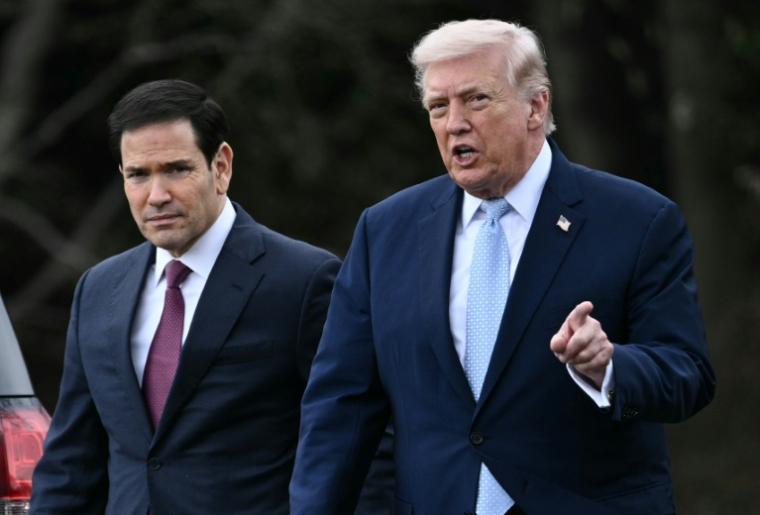
“What I said yesterday (Monday) was exactly right,” insisted the American president, specifying that his envoy Steve Witkoff, his son-in-law Jared Kushner, Vice President JD Vance, and Secretary of State Marco Rubio are involved.
By mentioning these talks, Donald Trump postponed his threat to strike Iran’s power grid “by five days,” temporarily reassuring the markets. He later congratulated Washington and Tehran for finding “major points of agreement” in the context of negotiations with a “senior Iranian leader.”
But who is this leader? The only certainty is that it is not Mojtaba Khamenei, the new Supreme Leader, who has been invisible since his appointment by Iranian authorities following his father’s death on the first day of the war, February 28th.
Mohammad Bagher Ghalibaf, President of the Iranian Parliament – presented by the Axios news site as the US interlocutor – denied any involvement. The Iranian diplomatic service admitted only to having received “messages conveying an American request for negotiations” via “friendly countries.”
While waiting for possible diplomatic progress, an Israeli-American strike hit the Bushehr nuclear power plant in Iran without causing damage, as confirmed by the Iranian organization for atomic energy in the evening. The International Atomic Energy Agency (IAEA) urged maximum restraint to avoid any nuclear safety risks during the conflict.
In Israel, 12 people were injured near Tel Aviv on Tuesday evening by one or more missiles from Iran, according to Israeli rescue services. And the risks of further escalation affect the entire region.
In Lebanon, where Israel wants to seize a large area in the south of the country for its security, Lebanese authorities have taken the unprecedented step of initiating expulsion proceedings against the Iranian ambassador for interference. However, they have also drawn the wrath of the pro-Iranian Hezbollah.
– “Large-scale strikes” –
On the ground, at least nine people were killed from Tuesday night to Wednesday in three Israeli raids on southern Lebanon, a region considered a stronghold of the pro-Iranian Hezbollah movement, according to Lebanon’s official ANI news agency.
In the Gulf, Bahrain, Saudi Arabia, and Kuwait reported drone and missile attacks by Iran on Tuesday.
Meanwhile, the Israeli army carried out “a series of large-scale strikes (…) in several regions of Iran,” including Isfahan.
“The sounds, explosions, and missiles are now part of our daily life,” said a 35-year-old Kurdish woman residing in Tehran, speaking to AFP by phone.
In Lebanon, explosions shook regions north of Beirut during the day.
On Tuesday morning, Israeli Defense Minister Yisrael Katz stated that Israeli forces were “maneuvering inside Lebanese territory to seize an advanced defense line” up to the Litani River, about thirty kilometers from the border.
“The hundreds of thousands of residents of southern Lebanon who were evacuated to the north will not return south of the Litani until the security of the residents of the north (of Israel) is ensured,” he warned.
:quality(80)/outremer%2F2026%2F03%2F18%2Fimg-6039-69babf3fe41b4355421143.jpg "Armed robbery in Saint-Laurent-du")