Diverse Folk Culture
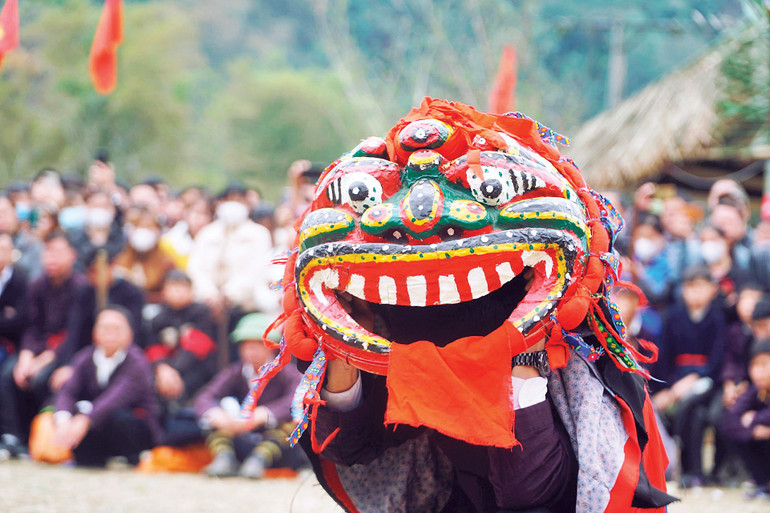
Lang Son province is home to many traditional folk songs and dances, such as Then accompanied by the zither, Sli and the lion and cat dance of the Tay and Nung ethnic groups; Pao Dung of the Dao ethnic group; and folk songs of the Black Hmong (Tu Si Na Mieo). Among them, the practice of Then, a cultural heritage of the Tay and Nung people of Lang Son, the indigenous population, is a form of folk expression that reflects both their spiritual life and artistic activities. The province currently has over 600 Then practitioners, 34 of whom have received titles of People’s Artist and Meritorious Artist in two categories: religious practice and folk performing arts.
Popular artist Ha Mai Ven, from Dong Dang commune, stated: “One of the peculiarities of Then lies in its language, which is rich in cultural content. Then songs reflect deep humanistic ideals, expressing love for nature, conjugal love, loyalty, moral principles, love for the village and country.”
Unlike Then singing, Sli singing is closely related to the daily life of the residents. In the Nung language, Sli means “poetry,” and Sli singing is a form of seductive singing where men and women exchange verses. There are three main styles of Sli singing: spoken singing (recitation of poems), Sli singing (recitation of poems), and high-pitched Sli singing. In Lang Son, the village style Sli slinh is popular among the Nung Chao ethnic group; the Nung Phan Slinh practice Sli sloong hao; the Nung Inh, Sli Inh; and the Nung An, Heo phun.
In 2019, the tradition of Nung people’s Sli singing in Lang Son province was recognized as a national intangible cultural heritage by the Ministry of Culture, Sports and Tourism. During festivals, holidays, and major events, it is not uncommon to see many Nung people gathering and exchanging Sli songs at the heart of the provincial center’s activities.
Historical documents indicate that the worship of Mother Goddesses appeared in Lang Son in the late 19th or early 20th century, following exchanges and the adoption of indigenous popular beliefs. A group of Kinh people settled there, engaged in trade, and brought their beliefs with them. Today, the worship of Mother Goddesses is an integral part of the spiritual and cultural life of Lang Son residents, alongside the indigenous beliefs of minority ethnic groups.
According to renowned geopark expert Prof. Tran Tan Van, Lang Son has long been a favorable area for cross-border trade. This, combined with historical changes, facilitated the settlement and trade of some Vietnamese (Kinh) population, who brought their beliefs with them. In Lang Son, several historic sites housing objects of worship associated with the Four Realms’ deities have been immortalized in popular songs, such as Bac Le temple dedicated to Chau Be Bac Le; Mo Ba temple dedicated to Chau Muoi; Suoi Ngang and Suoi Lan temples dedicated to Mau Lieu Hanh and other saints of the Four Realms system.
Lang Son currently has nine sites listed as national intangible cultural heritage and two sites of representative intangible cultural heritage of humanity (Tay and Nung people’s Then practice and Vietnamese belief in the Tam Phu Goddess). These popular cultural values are a source of pride for the residents of Lang Son and represent a precious source of their inner wealth.
Linking Conservation to Tourism Development
Lang Son province is committed to ensuring a harmonious and balanced approach between preserving, conserving, and promoting popular culture and tourism development to stimulate socio-economic development. According to Nguyen Dang An, Director of the provincial Department of Culture, Sports, and Tourism, the province has implemented many effective projects and programs since 2016.
Specifically, in 2019, the province issued Plan No. 117/KH-UBND regarding the implementation of the project “Preservation and promotion of traditional costumes of Vietnam’s ethnic minorities,” with a total budget of around 35.3 billion VND; in 2021, it issued Decision No. 741/QD-UBND regarding the implementation of the project “Preservation and promotion of Tay and Nung ethnic groups’ lion dance in Lang Son province for the period 2021-2030”; and in 2022, it issued Plan No. 42/KH-UBND regarding the implementation of the project “Preservation and promotion of ethnic minority folk songs, dances, and music within the framework of tourism development for the period 2021-2030,” with a total budget of over 80 billion VND.
“As part of the implementation of Project 6 of the National Target Program for socio-economic development of ethnic minorities and mountainous areas for the period 2021-2030, the Department has been collaborating since 2022 with relevant agencies and local authorities to successfully carry out several sub-projects. The Department has also established 12 folk art clubs, inspired by traditional cultural activities of ethnic groups, providing education and practical workshops on different forms of these arts…contributing to the development of unique cultural tourism products,” explained Mr. An.
The designation of Lang Son Geopark as a UNESCO Global Geopark marks an important milestone in the province’s cultural development. The province commits to preserving, restoring, and rehabilitating at least five historic sites per year; organizing three training sessions on intangible cultural heritage; and continuing the research and revitalization of traditional festivals of ethnic minorities in the geopark, thereby contributing to the development of an original tourism offering.
Mr. Hoang Xuan Thuan, Director of the provincial Center for Investment Promotion, Trade, and Tourism, stated that his organization had developed itineraries and tourist sites within the park, focusing on the theme “The flow of life in sacred land.” These itineraries connect iconic sites related to historical evolution and beliefs concerning the Mother Goddess cult in the Three Realms, exceptional cultural heritage sites, and natural landscapes. The tourist routes primarily utilize national routes 1A, 1B, 4B, and 279, facilitating tourist travel.
Politburo Resolution No. 80-NQ/TW dated January 7, 2026, concerning the development of Vietnamese culture, is considered a strategic decision encouraging territorial authorities to broaden their scope, identify their endogenous resources, and energize the development of indigenous culture in this new development phase. To effectively implement this resolution, Lang Son province must translate its policy commitment into concrete policies, allocate sufficient and targeted resources, and consider the preservation and promotion of indigenous cultural values not only as a sectoral mission but also as a responsibility linked to the commitment of every official, Party member, and citizen of the province to their homeland, Lang Son.
Source: https://nhandan.vn/bao-ton-va-phat-huy-gia-tri-van-hoa-dan-gian-post950242.html