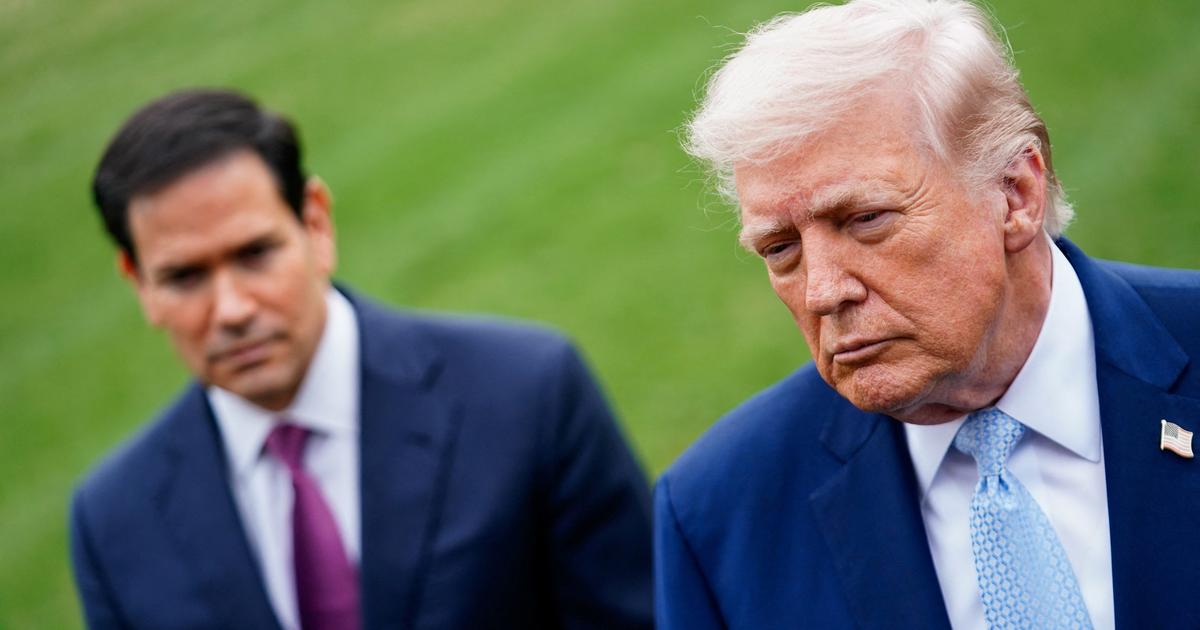
In this conflict, Donald Trump’s statements go in all directions. They do not give any idea of what is really happening. Hence the assumption that this war is not going as well as one would like in Washington and Jerusalem. And that the Iranian side seems much more capable of patience and endurance than the American side.
One morning, the president announces that the war’s objectives are “almost achieved,” that “the regime is anti.” The next day, from the same mouth, comes the phrase “the war will last as long as it takes.” He speaks of “the total destruction of the enemy Iranian’s missile launch capabilities” even as shots continue to hit Israel or states in the Persian Gulf.
Even an interpretation of these statements as “intoxication,” which would then just need to be decoded to draw reliable information from it, is doubtful. We are more in the random, the unhinged, and the bluster than in the calculated and calibrated formulation.
If the fanciful mutterings coming from the top in Washington inform very little, the same may not be true of what comes from Jerusalem.
Indeed, this war is inspired and led as much by Israel as by the United States. Without delving into considerations of possible “manipulations of the naïve Trump” by the “ingenious Netanyahu who absolutely desires this war,” one can hypothesize that the assessments from Jerusalem are less removed from reality.
Even if the announcements of successive eliminations of Iranian leaders may have sparked irrational jubilation and excessive optimism in Israel, last week we heard the prime minister consider, for the first time, the possibility of the current regime in Iran remaining in power and the impossibility of toppling it by airstrikes alone: “After all, a regime must collapse from within,” Netanyahu said.
Amos Harel, the security specialist at the Israeli newspaper Haaretz, goes even further. He points out that, since June 2025, more than half of the top Iranian leaders have been killed, but he asks, what benefit have the Israelis derived from it? The analyst writes that “the Tehran regime has shown remarkable resilience and a willingness to continue the fight.”
This regime could even, if it is still in place in a few weeks, and simply by virtue of its survival, claim victory in a war that is absolutely “horizontal and asymmetrical,” which it had evidently well planned, around the bottleneck of the Strait of Hormuz. “The hope of overthrowing the regime was based on excessive optimism; Israel is forced to lower its expectations,” concludes Harel.
Since the end of World War II, excluding several punctual military interventions (or “shadow maneuvers” by secret services), the United States has participated in five major wars—almost all of them lost. Neither in Korea (1950-1953), nor in Vietnam (1955-1975), nor in Afghanistan (2001-2021), nor in Iraq (2003-2011) did the American colossus achieve its objectives.
The first ended in an armistice, without changing the balance of forces. Kim Jong-un, heir to the unassailable North Korean communist dictatorship, is proof of this. In the other conflicts, the United States had to withdraw, more or less humiliatingly.
Only the first Gulf War (1990-1991), launched by George Bush Sr. to end the Iraqi invasion of Kuwait, can be considered a clear success.
But Washington later considered the mission unfinished, and Bush Jr. attacked Iraq in 2003 to overthrow Saddam Hussein’s regime. The immediate objective was achieved, but the country was subsequently bogged down in a horrendous war, ending with a withdrawal in 2011. Without stabilizing Iraq or making it a reliable ally.
Economically (in terms of oil), China was the late winner of this war, while Iran’s ayatollahs benefited greatly from expanding their influence in Baghdad.
It is worth pausing for a moment on the 1991 war, the first real American intervention in the Middle East. To drive out the Iraqi army from Kuwait, the United States did not act spontaneously.
They first built a vast international coalition of about forty countries—from Europe to the Arab states (including Syria). They then obtained a vote in the UN Security Council to “restore the borders” of Kuwait.
The operation went smoothly, although at the cost of the massacre of tens of thousands of Iraqi soldiers. After the defeat of Saddam Hussein’s army, some wished to continue the offensive to Baghdad. Wisely, Bush Sr. stopped at the border, where the legal mandate of the United Nations ended.
In contrast, the following deployments (Afghanistan, Iraq II, Iran) show a gradual deterioration of American military deployments, both in terms of legitimacy, legality, and (probably in 2026) effectiveness.
After September 11, the United States garnered broad support in a sympathetic international community towards Washington. While there was no vote at the UN to authorize the use of force, NATO invoked Article 5 in solidarity with the United States, and this intervention to drive out the Taliban, who were complicit with al-Qaeda, seemed largely legitimate.
Even so, after 20 years of unequal reconstruction of the country, the return of the Taliban to power could not be prevented. The ultimate humiliation for the United States, prepared by a hasty and haphazard agreement signed by Donald Trump in 2020.
The wars in Iraq in 2003 and Iran today are triggered by imaginary, variable, or unknown reasons. With legitimacy widely contested and effectiveness erratic. The near future will tell us whether this American-Israeli war in Iran can be interpreted as a sort of culmination of this process of decomposition.
To reach the author: francobrousso@hotmail.com.