A new laboratory ship for research on the “navigation of tomorrow”.
On May 23, 2026, at a shipyard in Flensburg, near the Danish border, the DLR (Germany’s research center for aeronautics and astronautics) laid the keel of a ship like no other: the MODULARIS! This is a laboratory ship designed to test technologies at sea that will impact the navigation of the future: hydrogen engines, ammonia, methanol, fuel cells, hybrid batteries, autonomous navigation, and onboard drones. Essentially, it is a maritime toolbox that floats and sets sail.
Presented as “unique in the world” by its president Anke Kaysser-Pyzalla, the project also sends a political signal: Europe does not want to leave Japan, Korea, and China alone in the field of maritime decarbonization.
Germany launches MODULARIS, a floating laboratory to reinvent maritime propulsion
Why a floating laboratory?
Testing a hydrogen engine in a lab is one thing. Running it in the North Sea at 8°C, with salt everywhere, under waves, for a week, is another. The big barrier between R&D and market deployment in the maritime industry lies in certification. Until a technology has been tested in real conditions in front of a classification society (DNV, Lloyd’s Register, Bureau Veritas, ClassNK), it remains on the shelf. This is exactly the hurdle that MODULARIS aims to overcome.
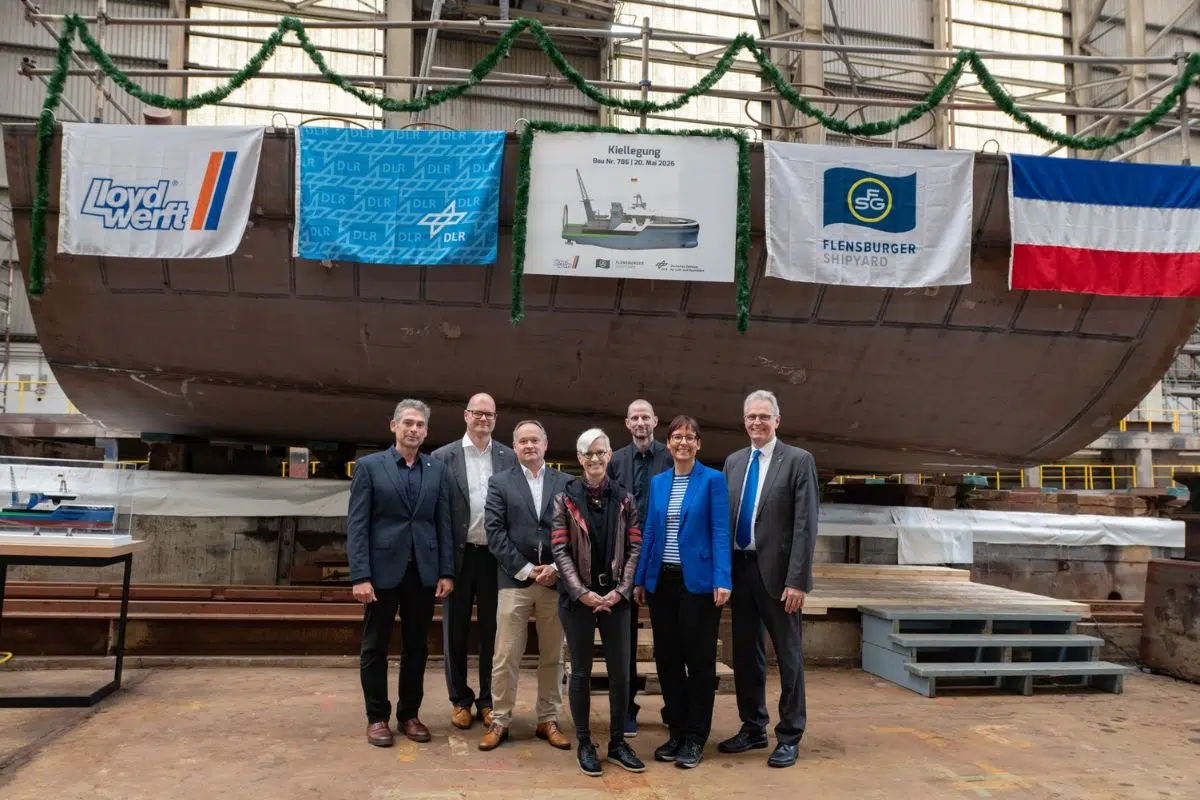
From left to right: Manuel Ortuño, Lloyd’s Register; Frank Mallon, CEO of FSG Shipyard; Thorsten Rönner, CEO of Lloyd Werft Bremerhaven; Anke Kaysser-Pyzalla, CEO of DLR; Sören Ehlers, Director at the DLR Institute of Maritime Technologies and Propulsion Systems; Meike Jipp, DLR Board Member for Energy and Transport Division; Karsten Lemmer, DLR Board Member responsible for innovation, transfer, and research infrastructures.
Credit: DLR (CC BY-NC-ND 3.0)
The ship will have a modular structure and will feature an experimental engine room where engineers can plug and unplug different propulsion systems, much like changing a printer cartridge. The ship will have fully redundant safety and control systems, allowing the testing of uncertified equipment without endangering the crew. To speed up the process, a digital twin of the ship will run continuously, simulating on land what is happening at sea.
The expected result is a significant reduction in the time between a prototype’s completion and its market entry. Currently, getting approval for an innovative marine engine takes five to ten years. With MODULARIS, DLR aims to cut this timeframe to a quarter or a third.
This “sea crane” has just succeeded in driving a 1,670-ton pile that will be followed by many others in the Hornsea 3 offshore wind farm.
The 2050 barrier
The IMO (International Maritime Organization) has set a net-zero 2050 target for global maritime transport, which currently accounts for around 3% of global greenhouse gas emissions. To achieve this, the agency has adopted a “Well-to-Wake” approach, meaning emissions must be accounted for not only when the fuel is burned, but throughout its entire life cycle, from production to combustion.
As a direct consequence, any fuel with high carbon content is automatically ruled out, even if it burns cleanly.
The European Union has added its own layer. Since January 1, 2025, FuelEU Maritime has mandated a progressive reduction in greenhouse gas emissions from maritime fuels: 2% in 2025, 6% in 2030, up to 80% by 2050. Since the same date, the EU’s emissions trading system (EU ETS) covers offshore and freight ships over 400 tonnes operating in European waters, making the maritime space closely monitored!
It’s no wonder that ship orders have shifted. According to Clarksons Research, in 2024, over half of new global orders were for ships using alternative fuels. Orders for conventional fuel ships have plummeted. MODULARIS arrives precisely at a time when the industry is shifting gears.
We often discuss this topic at Media24.fr, and you can find the latest articles in the list below:
| Date | Ship / Subject | Fuel | Description |
|---|---|---|---|
| 9 May 2026 | Ning Yuan Dian Kun (China) | Electric | The world’s largest all-electric container ship, 127.8 meters long with 20,000 kWh of batteries, in service on the Ningbo-Jiaxing route. |
| 31 March 2026 | Moteur 6UEC35LSGH (Japan) | Hydrogen | Japan unveils the first 2-stroke engine capable of powering a 17,500-tonne cargo ship with a majority of hydrogen, developed by J-ENG and Kawasaki. |
| 3 Sept. 2025 | Moteur 7UEC50LSJA-HPSCR (Japan) | Ammonia | World premiere at J-ENG’s Akashi plant with this 7-cylinder monster capable of running on ammonia alone, with -90% greenhouse gas emissions. |
| 29 June 2025 | Hydrogen via Electrolysis (China) | Hydrogen | China unveils an innovation that allows the production of hydrogen from tap water, paving the way for mass production for ships and industry. |
| 15 Feb. 2025 | Yara Clean Ammonia – NYK (Norway/Japan) | Ammonia | First global time-charter contract for a 40,000m³ gas carrier running on ammonia, scheduled for November 2026. |
| 13 Feb. 2025 | Largest Hydrogen Catamaran (Sweden) | Hydrogen | Sweden sets a new world record in maritime transport with the largest hydrogen catamaran. |
| 9 Feb. 2025 | eCSOV Bibby Marine (UK) | Electric (25 MWh batteries) | World’s first all-electric eCSOV vessel, with a 25 MWh Corvus Energy Blue Whale LFP battery, delivered in 2027 by Spanish shipyard Armon. |
| 24 Jan. 2025 | Moteur 2 L Hyundai/Kia/KIMM (South Korea) | Ammonia | First 2-liter engine running on 100% ammonia, applicable to vehicles, ships, and planes, developed by KIMM, Hyundai, and Kia. |
| 23 Jan. 2025 | Hydrogen-Electric Ship (Lithuania) | Hydrogen + Electric | Lithuania, a country of 2.8 million inhabitants, makes a mark by joining the elite ranks with a hydrogen-electric propulsion ship. |
| 26 Dec. 2024 | Dong Fang Qing Gang (China) | Hydrogen (fuel cells) | World’s first hydrogen barge container ship, 64.5 meters long, 1,450 tons, 550 kg of H2, and 2 Sinosynergy 240 kW fuel cells, reducing up to -700 tons of CO2 emissions per year. |
Â
What MODULARIS brings differently
DLR has publicly invited government agencies, industry, and especially SMEs and startups to come aboard with their own prototypes to test alongside them. MODULARIS thus claims a European common good mission, accessible to any actor able to present a credible prototype.
DLR also plans to expand its onshore facilities through this collaboration. New offices and laboratories with direct access to water are being constructed on the Mak Campus in Kiel, the capital of Schleswig-Holstein. The region has clearly decided to become Germany’s maritime innovation hub, similar to Brest for France or Trondheim for Norway.
The time gamble
The ship is currently only at the keel-laying stage. The builder, Lloyd Werft, estimates that the first tests for MODULARIS will take place in 2027 or 2028.
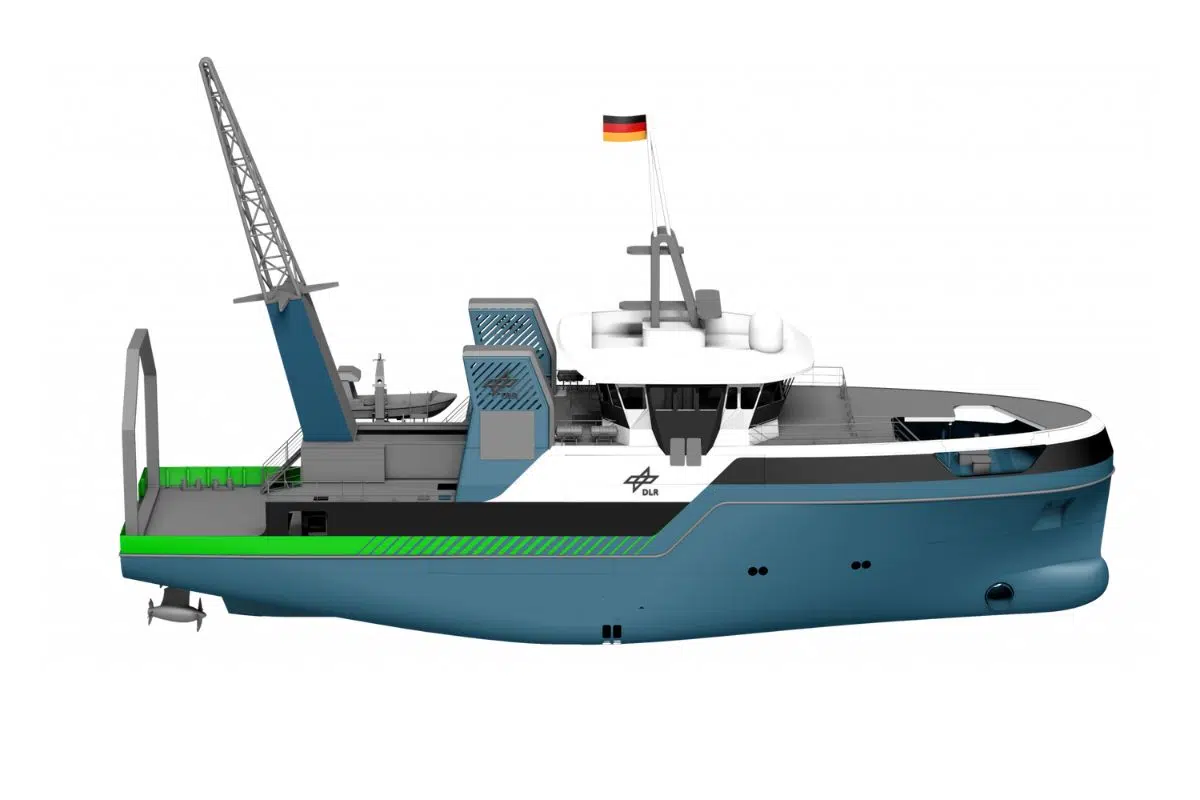
Once the hull is completed at the FSG shipyard in Flensburg, the ship is expected to be transferred to the Lloyd Werft shipyard in Bremerhaven in autumn 2026. It will be outfitted and completed in 2027.
Credit: DLR (CC BY-NC-ND 3.0)
If MODULARIS delivers on its promise (a real reduction in certification times), it can give the European marine engine industry a lead it has lost over the past twenty years to Korean and Chinese shipyards.
Sources:
- Maritime Journal, A floating laboratory onboard a research vessel (February 2025) https://www.maritimejournal.com/vessels/a-floating-laboratory-onboard-a-research-vessel/1499797.article
Announcement of the construction contract awarded to Lloyd Werft and initial presentation of the DLR project. - DLR (German Aerospace Center), DLR celebrates keel laying of the MODULARIS seagoing technology platform (date unspecified)
https://www.dlr.de/en/latest/news/2026/dlr-celebrates-keel-laying-of-the-modularis-seagoing-technology-platform
Press release announcing the keel laying of the MODULARIS maritime technology platform, an experimental ship intended to test autonomous and modular naval technologies.
Â



:quality(80)/outremer%2F2019%2F10%2F02%2F5d94b442a2f14_la-coupe-du-monde-football-2014.jpg "FOOTBALL. For the 2026 World Cup, discover NC la 1ères system for following the matches")