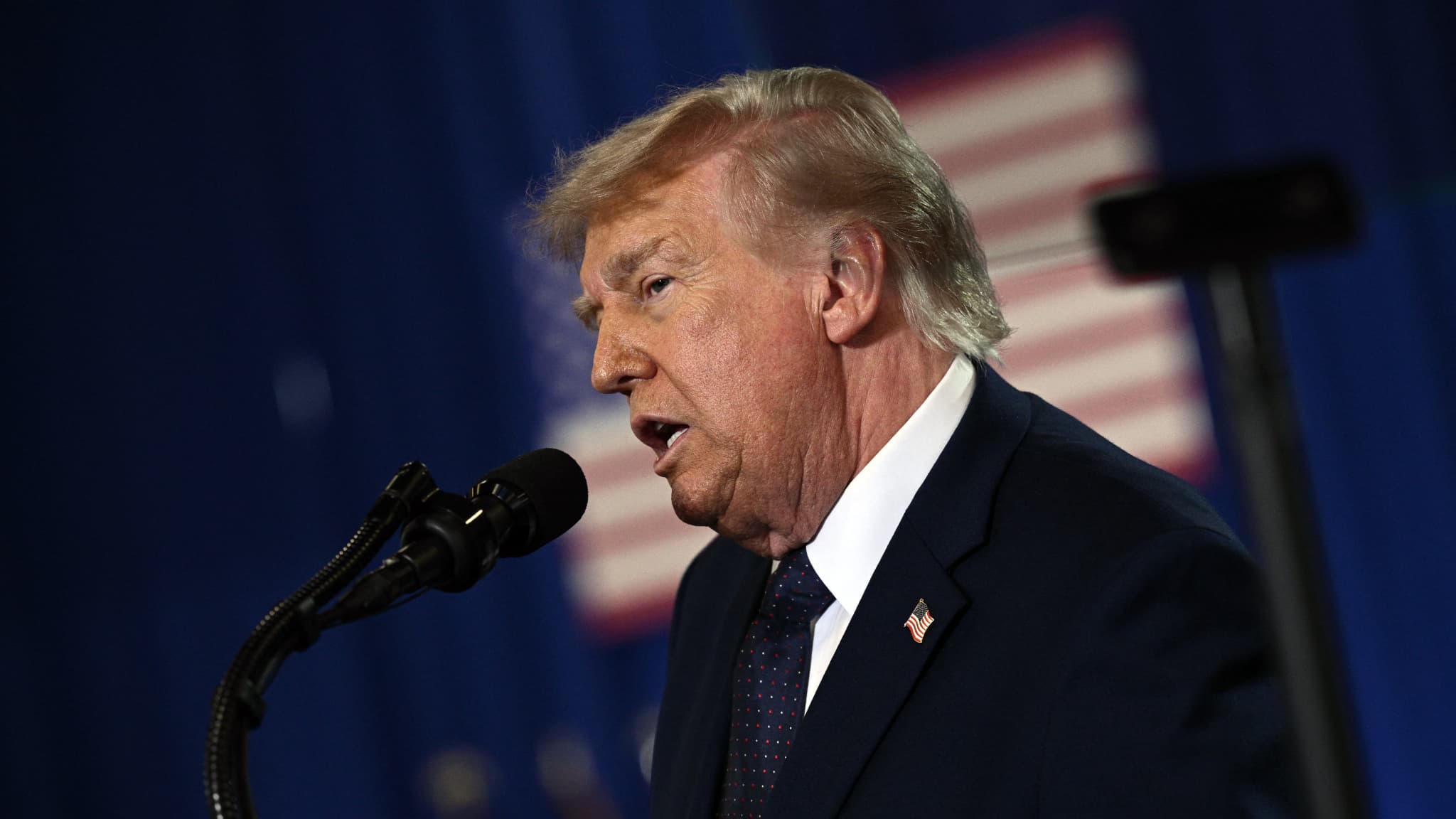
President Donald Trump indicated on Saturday that an agreement with Iran, including the reopening of the Strait of Hormuz, was “largely negotiated” following telephone discussions with Israel and other allies in the region.
“The final aspects and details of the agreement are currently being discussed and will be announced shortly,” Mr. Trump said on social media, without providing a timeline.
He mentioned speaking with the leaders of Saudi Arabia, the United Arab Emirates, Qatar, Pakistan, Turkey, Egypt, Jordan, and Bahrain, as well as separately with Israel.
He described it as a “peace agreement protocol” that still needs to be finalized by the United States, Iran, and other countries involved in Saturday’s talks.
He did not mention the Iranian nuclear program or highly enriched uranium, issues that Iran wished to address later.
Increasing optimism
The United States and Iran were on the brink of reaching an agreement to end the war, a regional official with direct knowledge of mediation efforts led by Pakistan said on Saturday, after the U.S. considered a new series of attacks against the Islamic Republic.
The official, speaking anonymously to discuss deliberations behind closed doors, warned that “last-minute differences” could thwart the efforts. This is not the first time in recent weeks that an agreement has been described as imminent.
The potential agreement would include an official declaration of the end of the war, along with two months of negotiations on the Iranian nuclear program. The Strait of Hormuz would be reopened, and the United States would lift its blockade of Iranian ports.
Iran reported a “narrowing of differences” in negotiations with the United States on Saturday after the Pakistani army chief held new talks in Tehran.
Both Iran and the United States reaffirmed their fundamental positions and warned of the risks of renewed attacks and a breakdown of the ceasefire.
A “framework agreement” for new negotiations
Iranian state television quoted Foreign Ministry spokesman Esmail Baghaei as calling the project an “framework agreement.”
“We want this to include the main issues necessary to end the imposed war as well as other critically important issues for us,” he added.
He mentioned that the Strait of Hormuz was among the topics discussed.
Positions have come closer in recent days, Mr. Baghaei noted, according to the official Iranian news agency IRNA.
“Over the past week, we have seen a trend towards reducing differences,” he explained. “We will have to wait to see what happens over the next three or four days.”
Mr. Baghaei stressed that nuclear issues were not part of the current negotiations, with Tehran seeking to end the war first before discussing its long-standing nuclear program, which has been at the heart of international tensions.
“At this stage, our priority is to end the war on all fronts, including in Lebanon,” Mr. Baghaei said, adding that lifting sanctions against Tehran “was explicitly included in the text and remains our unchanged position.”
Mohammad Bagher Qalibaf, the lead negotiator in last month’s historic face-to-face talks with the United States, said Iran had reconstituted its military capabilities and that if President Donald Trump resumed attacks, the outcome would be “more crushing and bitter” than at the beginning of the war.
He spoke after meeting with the Pakistani army chief, Asim Munir, according to state television.
Donald Trump had earlier said he was suspending a military strike against Iran as “serious negotiations” were underway, at the request of his allies in the Middle East. The U.S. president repeatedly set deadlines for Tehran before backtracking.
The United States and Israel triggered the war with attacks on February 28, prematurely ending talks with Iran. Tehran responded by effectively closing the Strait of Hormuz, a vital waterway for oil, natural gas, and fertilizers in the region, causing global economic difficulties.
The United States then blocked Iranian ports, and the U.S. Central Command said on Saturday that American forces had turned away more than 100 commercial ships and detained 4 since the start of the blockade on April 13.
Munir Ahmed, Samy Magdy, and Matthew Lee, The Associated Press