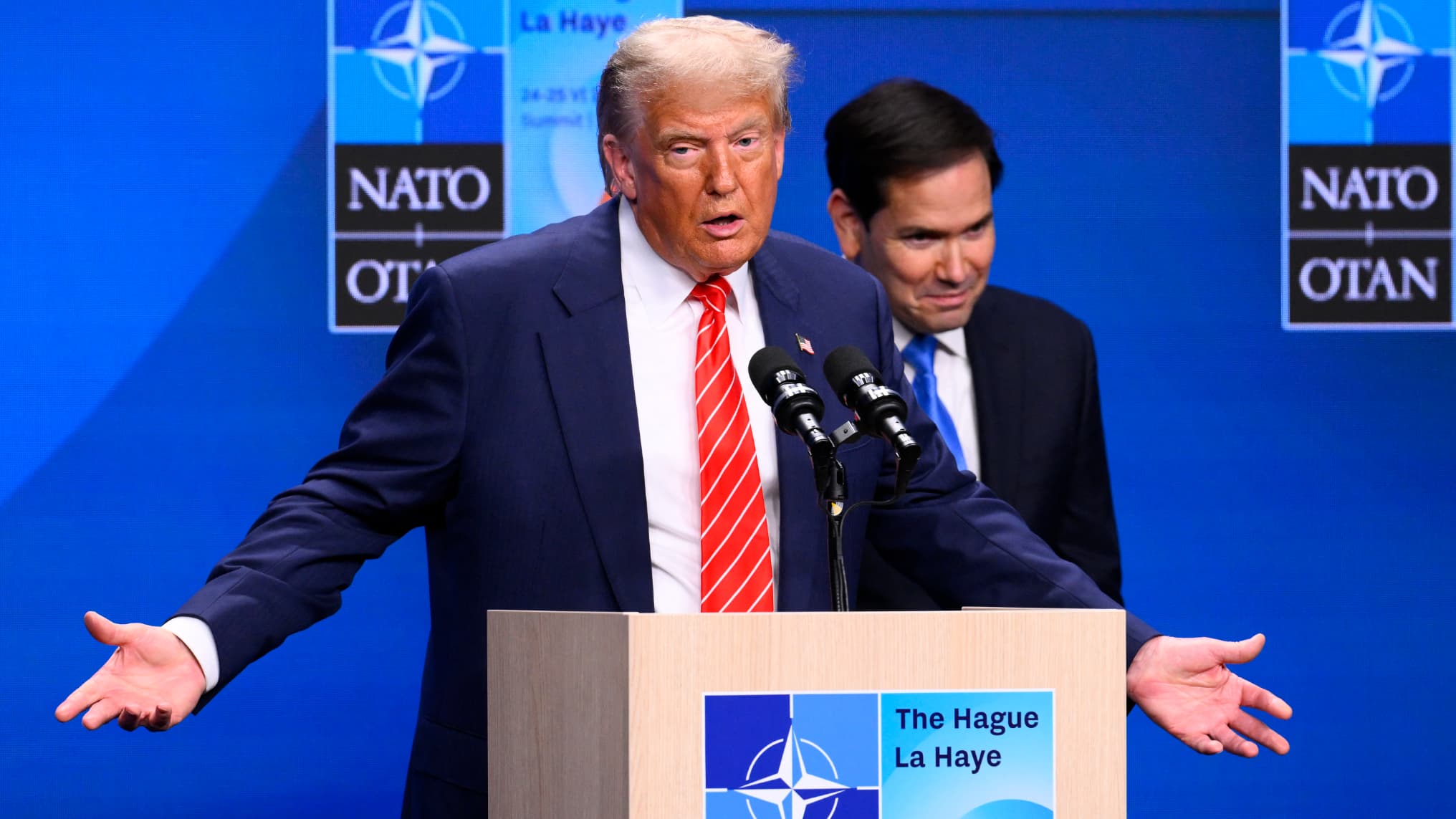
At the forefront – Nineteenth day of war: Trump increasingly isolated On Wednesday, March 18, on the nineteenth day of the war, Iranian missiles rained down on Tel Aviv. An attack justified by Tehran in retaliation for the assassination by Israel of Iranian national security supremo Ali Larijani. In response, Israel continued its missile strikes in downtown Beirut and promised to “track down, find, and neutralize” the new supreme leader Mojtaba Khamenei. In parallel, the United States announced targeting Iranian missile sites near the Strait of Hormuz. Donald Trump stated that allied countries, as well as China, “must participate” in securing the Strait of Hormuz by sending warships. An appeal that, until now, has been unsuccessful. Following a defense council meeting on Tuesday, March 17, Emmanuel Macron reiterated that France was “not a party” to the ongoing conflict in the Middle East. Similarly, German Chancellor Friedrich Merz, as well as British Prime Minister Keir Starmer, ruled out a NATO operation: “no one wants to actively participate in this war,” stated EU diplomatic chief Kaja Kallas. These statements come as Joe Kent, a high-ranking official in the Trump administration, resigned to show his disagreement with the conflict orchestrated by Washington, stating, “Iran posed no imminent threat to our nation.” In this context of military escalation and international reluctance, is Donald Trump finding himself increasingly isolated, on both the domestic and international stage? Guests: Emilie Baujard, senior reporter in the International department of RTL Adel Bakawan, director of the EISMENA Institute Laurent Larcher, senior reporter and Defense specialist at La Croix newspaper Remote guest: Fifi Abou Dib, journalist and columnist from L’Orient-Le Jour reporting live from Beirut Chronicles: “Word of the Day” by Mariette Darrigrand “What a Story!” by Olivier Ravanello BURNING QUESTION / Municipal elections 2026: What is the right playing at? On Wednesday, March 18, the head of the “Republicans” (LR) party Bruno Retailleau, who officially supported Christian Estroci (Horizons), refused to endorse the incumbent mayor of Nice who faces ex-Republicans president Éric Ciotti, an RN ally, in the second round of municipal elections, leaving the choice to voters “according to their heart and conscience”. “We had a national agreement with Horizons including Nice (but) this campaign has been chaotic,” declared the former Interior Minister, denouncing “calls to the left and identity politics” from the incumbent mayor. The campaign in Nice has indeed been brutal. Between accusations, “sound bites,” and defectors, Christian Estrosi, who trailed Éric Ciotti by a significant margin in the first round, 31% to 43%, has been calling for a broad coalition, including with the left, despite the fact that on the eve of the municipal elections’ first round, Bruno Retailleau, then a contender for the Élysée Palace, criticized the “shameful agreements” between the Socialist Party and France Insoumise. Xavier Bertrand, LR president of Hauts-de-France, criticized the decision not to support Christian Estrosi in Nice. “By refusing to reaffirm Republicans’ support for our leader in Nice, Bruno Retailleau is tacitly backing Éric Ciotti.” Does Bruno Retailleau’s redefinition of the right’s political line reignite the debate on the “union of the right”? Guests: Frédéric Dabi, opinion director at Ifop Bruno Cautrès, political scientist, CNRS researcher at CEVIPOF, and lecturer at Sciences Po Jean-Baptiste Forray, journalist and author of “Les frères ennemis de la côte” (Plon)