By the 1820s Phillipsburg had already been around a long time. Exactly how long is unclear. The earliest reference on a map is to the Native American village Chintewink that dated to the 1650s. An alley in the town bears that name to this day. Before that the Lenape tribe who lived there left no record.
Where its current name came from is unclear. Some said an old Native American chief was known as Phillip and it stuck. Others believe William Phillips, an early colonial landowner, had so much property that it just came to be called Phillipsburg after him.Â
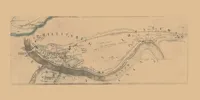
Map of Warren County, New Jersey, 1852 by D.M. McCarty
As early as 1739 a fellow named Daniel Martin established the first “ferry service†across that part of the Delaware. It consisted of a canoe with a rower, presumably Martin. The traveler’s horse waded across the river, its owner holding on to its reins.
Easton would not exist, at least not in any organized way, on the Pennsylvania side until the 1750s when Thomas Penn ordered that it be the seat of the newly founded Northampton County and named for his father-in-law’s British estate. By 1755 Easton was bustling with 40 dwellings and 5 taverns.
The Revolution came and the British and Tories went. The town grew but slowly. Most of the development took place in Easton.
According to a history provided on Phillipsburg’s website, by 1811 Phillipsburg consisted of fifteen families: Reese, Roseberry, Ramsey, Mixsell, Myers, Bullman, Albright, Seager, Barnes, Beers, Carpenter, Bidleman, Phillipps, Skillman and Shaup.
Things moved along as things will and by 1800 a bridge across the Delaware was built. It was a floating bridge and floated away a few years later. In 1805 the Easton Delaware Bridge Company held a lottery and raised enough money to build a bridge.
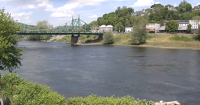
The Delaware River today, looking from Easton to PhillipsburgÂ
It was a covered structure, the first of its kind built in America and designed by Timothy Palmer (1751-1823) of New England. According to local architect Benjamin Walbert, Palmer was one of the leading bridge builders of the day. During the Revolution he was a Minuteman and fought at the Battle of Bunker Hill.
At its entrance the bridge bore the following warning: “Caution. Keep to the Right. All Persons Riding or Driving Over This Bridge Faster Than a Walk Will Be Punished As the Law Directs.†It survived many floods while her sisters were swept away by the raging Delaware.
It was only replaced in 1895 by the current structure designed by Lafayette College architect professor James Madison Porter III and whose style was said to be reminiscent of a bridge Porter saw over the Danube during a tour of Europe that was originally named for the Emperor Franz Joseph of Austria-Hungary. Heavily bombed during World War II, it is known as the Liberty Bridge.
The other major architectural work that shaped Phillipsburg in the early 19th century was the Morris Canal. The rise of the use of anthracite coal as an industrial and domestic home heating fuel led to an increasing demand as wood was fast disappearing in the early 1820s. But to get the “black diamonds†across the mountainous terrain of interior New Jersey was challenging.
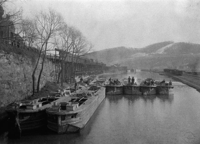
Morris Canal, Phillipsburg, Warren County, NJ
At the summer of 1822 Morristown businessman George T. MacCulloch was enjoying the refreshing breezes of Lake Hopatcong when an idea struck him. Why not build a canal using the lake’s water?
That August 29, 1822, a Morristown newspaper, grandly named “The Palladium of Liberty,†reported that a group of enterprising men from the region had held a meeting to study the possibility of building a canal from Newark using a series of inclined plane-placed canal boats that were raised and lowered. “The Newark Eagle” newspaper described it this way in 1830:
“The machinery was set in motion …. The boat, with two hundred people on board, rose majestically out of the water; in one minute it was upon the summit, which it passed apparently with all the ease that a ship would cross a wave of the sea. As the forward wheels of the car commenced their descent, the boat seemed to gently bow to the spectators and to the town below then glided quickly down the wooden way. In six minutes and thirty seconds it descended from the summit and reentered the canal, thus passing the plane one thousand and forty feet long with a descent of seventy feet in six and one half minutes.â€
A visiting English woman, Fanny Trollope, found at least one thing that she liked about America, writing in her 1832 book “Domestic Manners of the Americans”:
“We spent a delightful day in New Jersey, visiting, with a most agreeable party. The inclined planes are used instead of locks on the Morris canal. This is a very interesting work; it is one among a thousand which proves the people of America to be among the most enterprising in the world.â€
The technological marvel of the 1820s and 30s it was hoped would spur growth in Phillipsburg, but according to a later history book it did little of that. The economic panic of the 1840s led most of its backers to bankruptcy. Despite this it was able to prosper and flourish through the Civil War.
In 1861 Phillipsburg officially would become incorporated as a town.
By then things had begun to recover and the town began to bustle with the creation of the Phillipsburg Land Company where the large estates were broken up and sold for homes and businesses. “In all they brought three hundred acres, laid out eleven hundred thirty lots and paid for lands $55,000,†notes one source. The reason for this growth was the arrival on July 1, 1852, of the New Jersey Central Railroad.
Where the Morris Canal had been only a partial development, the arrival of “the cars†as that era called railroads, connected Phillipsburg to the rest of the East Coast in a way nothing else had. By the 1870s it was possible to have a doctor’s appointment or business meeting in New York or Philadelphia and return home to Philipsburg the same day.
Jobs in industry and professions increased and flourished, although with these changes came problems including labor unrest that struck the Reading Railroad and other Lehigh Valley industries in the 1870s hard. The militia was called out. This did not make Phillipsburg different than many places across the land. In 1905 President Theodore “Teddy†Roosevelt and his party stopped at the town and he made a speech to the crowd gathered at the station.
In 1911 a local historian noted that Phillipsburg had grown from a population of 1,500 in 1860 to one of 14,000 and was fully a part of the industrial northeast.
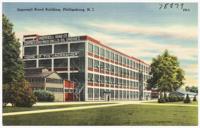
Ingersoll Rand building, circa 1930-1945
The arrival of the Ingersoll Rand Company in 1903 added more to the area’s industrial identity. With its departure in the early 2000s, Phillipsburg, like a lot of other communities, faced a crisis.
Today it looks forward to celebrating its 165th anniversary. “This anniversary is a celebration of generations who built it and their shared vision will guide us forward,†notes Phillipsburg Mayor Randy Piazza Jr.

/image%2F1371318%2F20260509%2Fob_fda861_mmexport1777037463936.jpeg "Chinese Film Festival in France: here we go !!")