Grape seeds found at archaeological sites may seem insignificant. However, the analysis of their DNA provides access to the millennia-old history of cultivated vines.
We sequenced the genomes of seeds several millennia old, revealing a history glimpsed by archaeology: the introduction of viticulture in France, the exchange of varieties on a European scale, and ancient farming practices that have left traces to this day.
Our results, recently published in Nature communications, show that some emblematic grape varieties, such as the flagship Pinot Noir of Burgundy, were already present in the Middle Ages.
How did we analyze the DNA of 4,000-year-old grape seeds?
The history of vines has long relied on morphological studies of grape seeds. This powerful approach has allowed us to distinguish major trends, such as wild or domestic characteristics of seeds, and trace the origins of viticulture.
However, some questions remained difficult to resolve: the geographic origin of varieties, parent relationships, or the modes of propagation (crossbreeding or clonal reproduction) and circulation of plants. Ancient DNA, preserved at the core of grape seeds, provides decisive assistance here, serving as a witness to the relationships between vines of the past and those of today.
We analyzed 49 seeds from various archaeological sites, mostly French, spanning over 4,000 years, from the Bronze Age to the end of the Middle Ages. These waterlogged seeds were preserved in specific, humid contexts, contributing to the good preservation of their DNA.
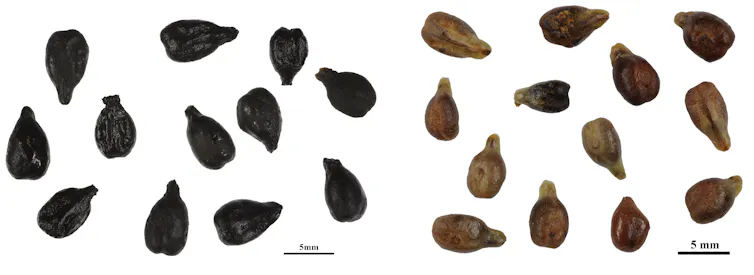
S. Ivorra, CNRS, Provided by the author
The DNA was extracted in the specialized ancient DNA laboratory of the Toulouse Center for Anthropobiology and Genomics, designed to isolate and manipulate molecules as rare and degraded as those that have survived through different eras in archaeological remains. This ancient DNA was decrypted thanks to cutting-edge sequencing technologies, allowing the entire genetic information, about 500 million letters, to be read.
These data enable the establishment of genetic relationships between individuals, the identification of grape origins, and the rediscovery of past propagation techniques: either through crossbreeding, mixing varieties of different origins or qualities; or through clonal reproduction (by cuttings, layering, or grafting) to maintain a valuable variety throughout time.
Our discovery proves the antiquity of viticulture
The first cultivated vines appear in France around -600 BCE, with the development of Mediterranean exchanges, particularly of wine. They coexisted with local wild vines, and crosses between these two types contributed to grape diversity.
Genetic analyses also confirm the existence of long-distance movements from that period. Influences from Iberia, the Balkans, or the Near East attest to the exchange of plants and expertise on a Mediterranean and, more broadly, European scale.
Another important point: clonal multiplication appears as an ancient and common practice, in place since the Iron Age. It allowed certain varieties to be maintained over long periods and spread over long distances.
In this context, we identified a medieval seed considered genetically identical to the current Pinot Noir, illustrating the continuity of some varieties over several centuries.
What are the prospects for this research?
Ancient DNA not only confirms existing scenarios but also opens up new avenues.
By combining ancient and modern data, it becomes possible to further characterize ancient vines. Recent approaches could infer certain characteristics of ancient grapes, such as berry color or taste-related traits.
These methods could also help understand vine adaptations to past environments, or the choices made by ancient societies in their agricultural practices.
In the long run, this research contributes to better documenting the genetic diversity of the vine and its evolution, an important issue in the current context of climate change.
Everything you need to know in three minutes about recent research results, explained and contextualized by the researchers who carried them out, that’s the principle of our “Research Briefs.” A format to find here.