An artwork fragmented in front of rigorous scientific methodology
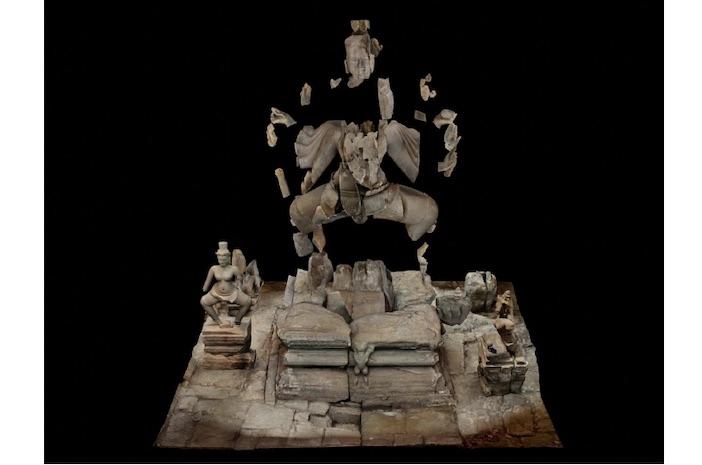
When the EFEO teams intervened at the Koh Ker site, the statue was reduced to thousands of scattered fragments. More than 10,000 pieces were collected, including about 2,750 identified and documented sculpted elements.
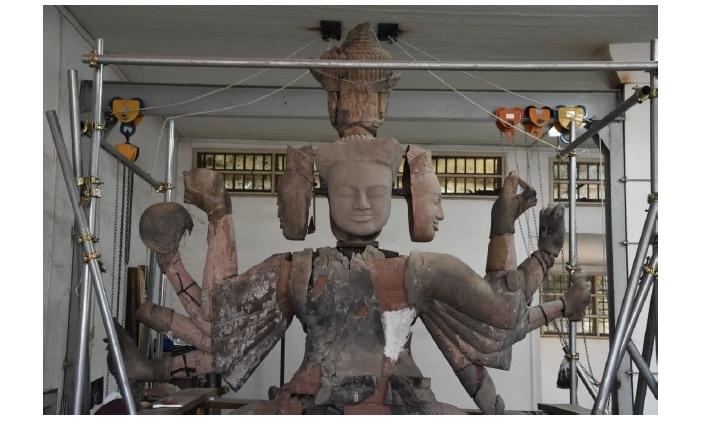
Facing this extreme fragmentation, the EFEO embarked on an in-depth preparatory phase between 2012 and 2019. The objective was clear: to transform a set of unstable remains into a structured scientific corpus.
“These investigations transformed thousands of vulnerable fragments into a documentable and exploitable corpus,” the EFEO pointed out.
EFEO, pillar of scientific coordination
The EFEO’s involvement was not limited to field intervention. It ensured the scientific direction of the project, structuring the data, coordinating partners, and defining methodological choices.
Under the direction of Éric Bourdonneau, the institution set up a comprehensive database integrating surveys, photographs, and digital reproductions. This work identified nearly 700 connections between fragments, paving the way for a partial reconstruction of the artwork.
This coordination role also extended to the establishment of a scientific and technical committee responsible for validating the site’s orientations.
The decisive contribution of digital technologies
One of EFEO’s major contributions lay in the integration of digital tools into the restoration process.
Each fragment was scanned in three dimensions, allowing virtual testing of assemblies. This approach limited physical manipulations and confirmed hypotheses before any intervention.
Mastered engineering serving stability
The operational phase, conducted from 2019 at Angkor Conservation, is based on precise technical choices.
EFEO supervised the design of an internal metal structure, organized around a central core anchored in a steel base. This device ensures the stability of the whole while remaining discreet.
The fragments are consolidated using metal rods and assembled with adapted mortars, composed notably of sandstone powder and lime. Specific work is done on integrating shades to preserve the visual coherence of the whole.
An ethical approach claimed
EFEO adopted a clear line: to intervene without artificially reconstructing the artwork.
Restorations were only carried out when the data was reliable enough. Otherwise, gaps were retained to make the transformations and destruction suffered over time visible.
“The goal is to restore the readability and monumentality of the artwork while leaving visible traces of its history.”
Transmission, means, and mobilization
Beyond restoration, EFEO’s action is framed in a logic of transmission.
Over twenty trainee restorers participated in the project through five dedicated sessions on sculpture conservation. This educational dimension contributes to strengthening local skills and ensuring the sustainability of know-how.
The project cost approximately 480,000 euros, mobilized with the support of international partners.
Under the coordination of EFEO, 11 different trades were involved, bringing together restorers, archaeologists, engineers, historians, conservators, and geologists. The restoration required 600 days of work, in addition to 215 days dedicated to the structure’s design.
This diversity of skills illustrates the scope of the work coordinated by the institution.
An intervention inscribed in continuity
Through this project, EFEO confirms its historical role in the study, preservation, and transmission of heritage in Southeast Asia.
The restoration of the Shiva of Koh Ker thus fits into a continuity: that of an ancient scientific presence, combining field research, methodological innovation, and cooperation with Cambodian institutions.